
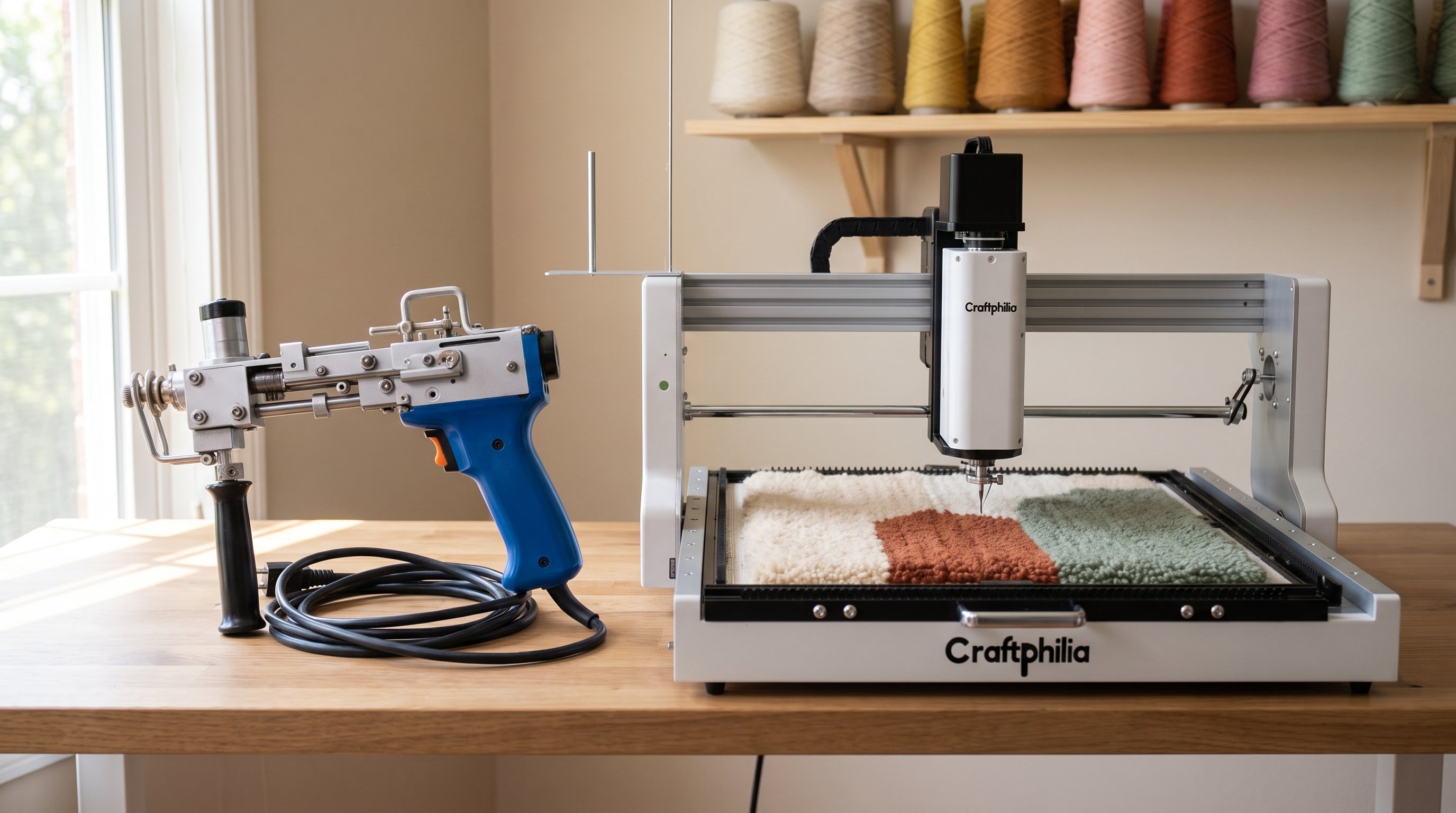
If you want to make rugs, wall art, or custom textile pieces, the tool you start with shapes everything that follows — how long each piece takes, how much you spend before your first finished rug, and how many of your ideas actually get made.
There are two realistic ways in: a tufting gun, or an automated tufting machine.
This guide compares both on the things that actually decide it — cost, learning curve, time per rug, and what each one is genuinely better at.
The short version
| Tufting gun | Automated tufting machine | |
|---|---|---|
| How it works | Handheld — you control the path, speed and tension | You upload an image; the machine tufts it on its own |
| Realistic all-in start | $395 – $895 | From $699 |
| Classes needed | Common — $85–130 US / £95–150 UK per session | None |
| First rug you're happy with | Usually the 2nd or 3rd attempt | The first one |
| Your hours per rug | All of them | Setup, yarn colour changes and finishing — the machine tufts on its own in between |
| Max size | Limited only by your frame | Set by the machine's tufting area — expandable on current models |
| Yarn | Any weight, any material | Acrylic, wool and blends in the 5 mm range |
| Best for | People who want the craft in their hands | People with ideas they want made |
Two numbers stand out. The all-in cost is closer than most people expect — by the time you've bought a full gun setup and taken a class or two, you're in the same range as an automated machine. And the time cost isn't close at all.
What each one actually is
A tufting gun is a handheld electric tool that punches yarn through a backing cloth stretched on a frame. It's far faster than tufting by hand with a needle, but it automates only the punching. You still control where the tool goes, how fast, at what angle, and with how much pressure — for every row of every rug.
An automated tufting machine moves the needle for you. You upload an image, the software separates it into yarn colors and generates the tufting path, and the machine executes it. You load the yarn and press start.
The distinction that matters isn't "manual versus automatic." It's which part of the work gets automated. A gun automates the muscle. An automated machine automates the execution — the repetitive, learnable, mechanical part — and leaves the decisions with you.
The cost most people don't add up
The sticker price of a tufting gun is genuinely low. The cost of starting to tuft with one is not the same number.
| What you need | Typical cost |
|---|---|
| Tufting gun (cut pile or duo) | $80 – $260 |
| Frame | $60 – $150 |
| Primary tufting cloth | $25 – $40 |
| Starter yarn | $60 – $120 |
| Tufting glue / adhesive | $25 – $40 |
| Backing fabric | $20 – $35 |
| Scissors, carving shears or trimmer | $40 – $120 |
| Beginner class (optional but common) | $85 – $130 |
| All-in | $395 – $895 |
A typical class runs two and a half to three and a half hours and sends you home with one 40 × 40 cm piece. Many studios do the gluing, trimming and backing for you afterwards — which means the part beginners struggle with most is the part you don't actually practise.
Compare that to a Craftphilia CF05 at $699, which arrives with tufting cloth, a starter pattern and matching yarn in the box.
This isn't an argument that guns are overpriced. It's an argument that the two routes cost roughly the same to start — so the choice should be made on what you want, not on what looks cheaper on the shelf.
Then there's the cost that appears on no receipt. Experienced tufters still put hours into a piece they're satisfied with. Beginners usually aren't happy until their second or third rug — that isn't a lack of talent, it's simply how long tension, angle and yarn behaviour take to become instinct. If you put any value at all on your own hours, that's the largest line in the table above, and it's invisible.
Automation doesn't replace your creativity — it removes what stands in front of it
This is the objection worth addressing directly, because it's the one people feel rather than say: if the machine makes the rug, is it still mine?
Consider what a machine can and can't do.
It can't decide that your dog's portrait would look better cropped tighter. It can't choose the four yarn colours that make an image work as a textile instead of as a photograph. It can't tell you the logo needs simplifying before it will read at floor level. It can't decide that a piece needs a deep carved edge to feel finished. Every decision that makes a rug yours is still yours.
What it removes is the execution barrier — the months of practice standing between having an idea and being able to make it well.
That barrier has never been a test of creativity. It's a test of manual repetition. Plenty of people with strong visual instincts never make a rug at all, because the distance between "I can picture it" and "I can produce it cleanly" is measured in dozens of practice hours they don't have. Autofocus didn't make photographers less creative — it let more of them get the shot they were already seeing.
The same logic applies here. The gap has never been the idea. It's the hours between the idea and the rug. Upload the image, and the machine takes on the bulk of those hours — you step in to change the yarn when the design moves to a new colour, and again at the end to finish it.
And the finishing stays with you: the trimming and carving that turn a flat surface into something with depth is hands-on work — and it's the part most tufters wanted to keep anyway.
If you already tuft, this is a capacity decision
Everything above is written for someone deciding whether to start. If you own a gun, know what you're doing and take orders, the calculation is different — and it has nothing to do with the learning curve. You're past that.
It's about your ceiling.
A working tufter's output is capped by their own hands. Every rug is hours you personally stand at the frame, which means both your production and your income are limited by how many of those hours you're willing to give. The usual answer is hiring — slow, expensive, and it means training someone to your standard.
An automated machine raises that ceiling without adding a person. The repetitive execution comes off your plate; the design decisions, the finishing and the client relationships stay with you. More finished pieces per week means more you can sell — and more hours left for the parts of the business only you can do.
When a tufting gun is the better buy
We'd rather say this here than have you discover it after delivery.
If budget is genuinely the constraint. A basic gun and a minimal setup can be had for under $400 if you skip the class and buy carefully. If you're not yet sure tufting will stick, that's a reasonable way to find out.
If the making is the point. Some people don't want the work removed. They want the tension, the angle, the slow build of something that came out of their own hands from the first row to the last. That's a real reason, and no machine answers it.
If you need to work outside the machine's range. Our machines are built around a 5 mm yarn specification — acrylic, wool and blends all work within it — and each model has a defined tufting area that an Expansion Kit widens. Room-sized rugs, or very chunky and very fine yarns, sit outside what our current machines cover. A gun doesn't have those limits.
If you need it to travel. Guns go to workshops, markets and classes. A benchtop machine stays on the bench.
How to decide
- Do you want to learn the craft, or make the work? If the answer is "learn the craft," buy a gun. That's not a compromise — it's a different goal, and a machine won't satisfy it.
- How many rugs do you actually want to make? One or two a year: a gun is fine, and the time cost never adds up. One or two a month: the time cost dominates everything else.
- What's the largest piece you need? Check it against the tufting area of the model you're considering — if your work needs to go beyond what our current machines cover, the decision is made for you.
- Is your ceiling your own hands? If you're selling and turning down work, that's a capacity problem — and capacity is what a machine buys.
Whether you're making your first rug or scaling a rug business, the right tool changes the entire experience — and there isn't a single right answer for everyone.
Compare Craftphilia machines →
Frequently asked questions
Is an automated tufting machine hard to use?
No prior tufting experience is needed. You upload a JPG or PNG, Craftphilia Studio previews the finished result and generates the path, and you send the job to the machine over Wi-Fi.
Do I still need to finish the rug by hand?
Yes. Trimming, carving and backing are hands-on. Every machine ships with the cloth, pattern and yarn you need to complete your first rug out of the box.
Can I use my own yarn?
Yes. Craftphilia machines are built around a 5 mm yarn specification rather than a single material — acrylic, wool and blends all work, and third-party yarn in that spec is fine. We recommend our own because we've tested it, and yarn outside the spec that damages the machine isn't covered by warranty.
Does it change yarn colours by itself?
No. The machine tufts each colour section on its own and pauses when the design moves to the next colour, at which point you load the new yarn. There's no limit on how many colours a rug can use — more colours simply means more stops. Single-colour and simple designs run start to finish with almost no input.
Is it noisy?
There's some light mechanical noise while it runs — easy to share a room with.
How long does a rug take?
Between one and five hours of machine time depending on size and design. You don't need to stand over it — the machine tufts each colour on its own and pauses when it's time to load the next one.
Share:
The Complete Guide to Automated Tufting Machines