
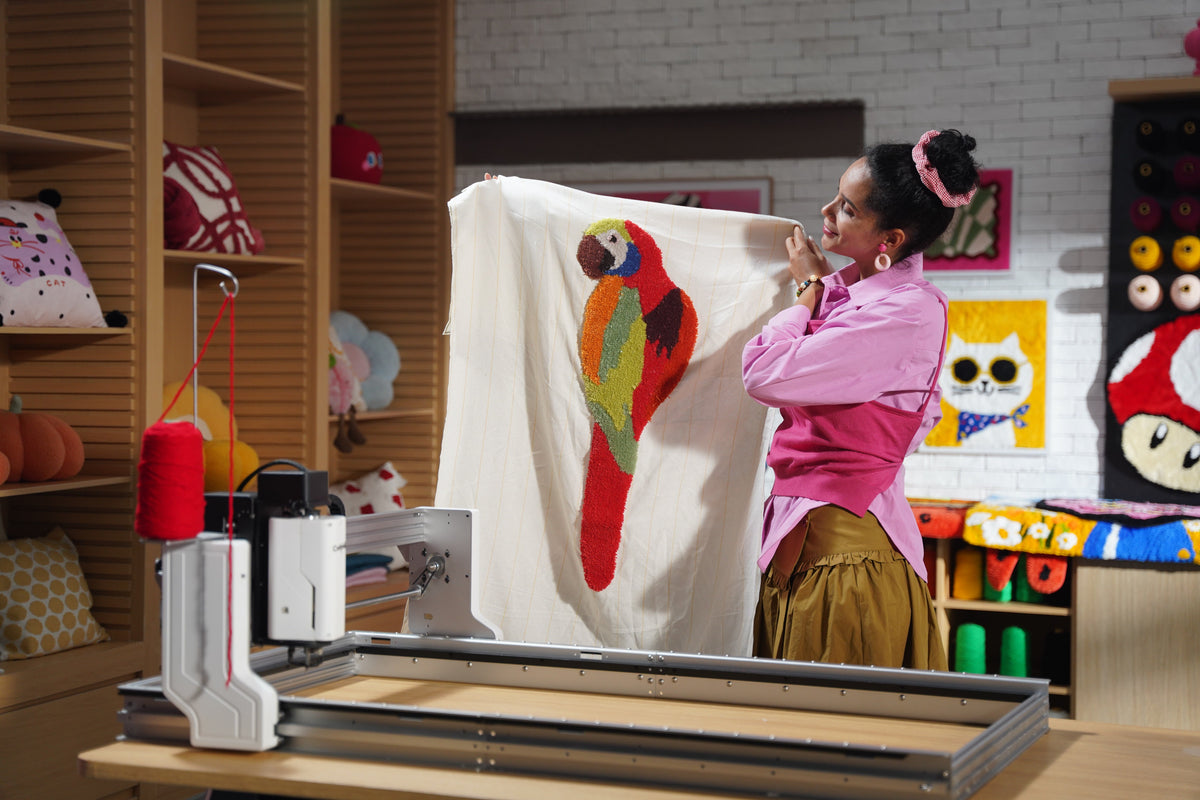
Every tufted rug you have ever seen was made the same way: someone standing at a frame, holding a gun against stretched cloth, guiding every single line by hand.
Steady hands, steady pace, hours on your feet. Gun or needle — until recently there was no third option.
An automated tufting machine is that third option. You upload an image, the software turns it into a tufting path, and the machine runs it line by line, colour by colour, while you do something else entirely.
This guide covers how these machines actually work, what they do and don't handle, what
you need to run one, and how to choose between the two models available today.
How an automated tufting machine works
The whole system is three things: a machine, a frame, and a free desktop app called Craftphilia Studio. The machine sits on a flat table, connects to your computer over Wi-Fi, and runs jobs you set up in the software. If you have ever sent a document to a printer, the shape of this will feel familiar.
Here is the workflow, start to finish.
1. Upload your image
Studio runs on Windows and macOS. Drop in a photo, a sketch, a logo — anything. The software separates the image into colour regions and generates the tufting path on its own, then shows you a preview of the finished piece before anything gets made. You can adjust the colours and refine the path from there. (For a closer look at what Studio does, see the Craftphilia Studio page.)
2. Load the frame and connect
Stretch tufting cloth over the included frame, thread your yarn, connect over Wi-Fi, and send the job from Studio.
3. Press start
The machine tufts on its own — moving the needle along the generated path at up to 800 stitches per minute with ±0.5 mm positioning accuracy. Lines come out clean and consistent with no guiding on your part. This is the part that used to take hours of your full attention, and it is the part you now spend elsewhere.
4. Swap yarn between colours
The machine does not switch colours by itself. When it finishes one colour region it pauses and waits. Load the next yarn, press resume, and it picks up exactly where it stopped. A five-colour piece means four pauses, each under a minute. There is no limit on how many colours a design can use.
A single piece typically runs one to five hours depending on size, colour count and pattern complexity. Between colour changes the machine runs unattended.

What changes when the tufting is automated
The obvious answer is time. The more interesting answers are the ones people only notice a few pieces in.
Complexity stops being expensive. By hand, every additional colour and every fine detail costs you real hours and real risk. A twelve-colour design is a different undertaking from a three-colour one. To a machine following a generated path, it is the same job with more pauses in it — which means the design you actually wanted stops being the one you talk yourself out of.
You can iterate. Running the same design twice in different palettes is a decision rather than a fortnight. That changes how you develop work: you try the version you are unsure about instead of committing to the safe one.
Consistency becomes repeatable. If someone wants the same piece again — a second cushion, a matching set, a repeat order — you send the same file. The tenth one comes out like the first.
You start without technique. There is no period of practice pieces before you make something you would put on a floor. Whether that appeals depends entirely on whether the manual craft is what you came for, which is a genuine fork in the road and worth being honest with yourself about.
What the machine handles, and what stays with you
The machine covers the tufting: every stitch, every line, every fill. You do not guide anything, hold an angle, or maintain spacing.
After the last stitch comes finishing — gluing the back, letting it cure, adding a backing layer, then trimming and carving the pile. Today that work is hands-on, and it is roughly half the total job. It is also where a piece gets its clean edges, even pile and a back worth flipping over. (We walked through the whole process in What Is Rug Finishing.)
Two other things worth knowing before you buy:
-
Both models produce cut pile. If loop pile is part of your work, a tufting gun handles that — we compared the two here.
-
Pile height is set by the machine, at 14–16 mm before trimming. Carving after the fact is where you shape depth and texture.
What you need to get started
-
A flat table. Sturdy enough to hold 17–23 kg without wobble. The CF05 needs roughly 85 × 72 cm of surface; the CF07, about 105 × 92 cm.
-
A computer with Wi-Fi. Windows or macOS.
-
That's it. Tufting cloth, a starter pattern and matching yarn ship with every machine. You tuft your first piece with what is in the box.
Which leaves one real decision: which size fits the work you want to make.
CF05 or CF07: which size fits you
Same software, same stitch mechanism, same build. The difference is how much tufting area you get.
| CF05 | CF07 | |
|---|---|---|
| Tufting area | 500 × 500 mm | 700 × 700 mm |
| Max area (with Expansion Kit) | 500 × 1000 mm | 700 × 1400 mm |
| Machine size | 850 × 720 × 450 mm | 1050 × 920 × 450 mm |
| Size with Expansion Kit | 850 × 1220 × 450 mm | 1050 × 1620 × 450 mm |
| Weight | 17 kg (20 kg with Kit) | 19 kg (23 kg with Kit) |
| Tufting speed | 800 stitches / min | |
| Pile height (before trimming) | 14–16 mm | |
| Dual-yarn tufting | Yes | |
| Colours per rug | Unlimited | |
| Yarn | 5 mm — acrylic, wool and cotton, third-party compatible | |
| Power | 24 V | |
| Software | Craftphilia Studio, free with updates | |
| Warranty | 12 months | |
Choose the CF05 if your work stays within 50 cm — coasters, mug rugs, wall pieces, small accent rugs. It covers all of that for $150 less, and takes up noticeably less table.
Choose the CF07 if you are already thinking about larger formats, or suspect you will be. The wider base and taller expansion ceiling give you somewhere to grow into, and the gap in price is smaller than the gap in what you can make.
Both take the optional Expansion Kit, so neither locks you into its base size. See the full
Frequently asked questions
Can it tuft a photograph, or only simple graphics?
Any image works. Studio converts photos, drawings and logos into a tufting path automatically, and supports JPG, PNG and BMP files.
What happens if the yarn breaks or tangles during a run?
The machine detects it and pauses. Reload or untangle the yarn, press resume, and it picks up where it stopped — you don't lose the piece or start over.
Does it need assembly out of the box?
Minimal. The machine arrives partially assembled and you finish the rest by following a
step-by-step video. No special tools, no experience needed, and it's a one-time setup.
Can I leave it running and walk away?
Between colour changes, yes. A single-colour piece runs start to finish without you. On a multi-colour design the machine pauses when it's time to load the next yarn and waits until you're back.
How loud is it?
There's some light mechanical noise while it runs — easy to share a room with.
What are the rules for running it around children or pets?
The machine is very safe in normal use and doesn't need you standing over it. One rule applies while it's running: never touch the moving parts or reach into the tufting area, and keep young children supervised around a machine that's in motion.
Do I have to use Craftphilia yarn?
No. The machines are built around a 5 mm yarn specification rather than a single material — acrylic, wool and cotton all work, and third-party yarn in that spec is fine. We recommend our own because we've tested it, and yarn outside the spec that damages the machine isn't covered by warranty.
Share:
Tufting Gun vs Automated Tufting Machine: Which Should You Buy?
How to Choose the Right Tufting Machine Size