
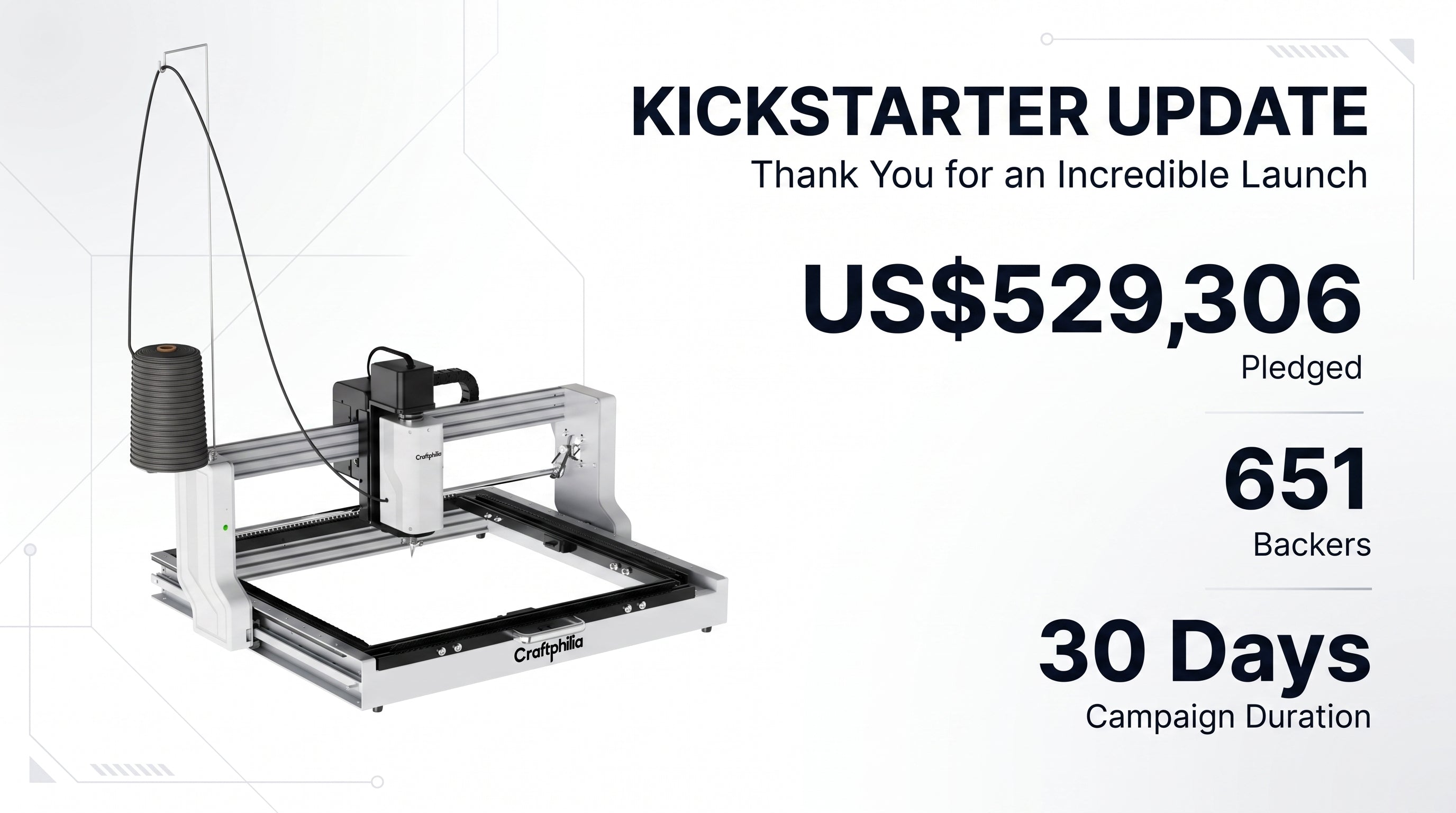
651 backers. US$529,306 pledged. The campaign closed on 16 July and we've moved into fulfilment.
We hit the funding goal in the first five minutes, passed the $500K stretch goal, and finished at 5,262% of target.
Thank you. Not one of those 651 people had ever used the machine. They backed what they saw in the demos and trusted us with the rest — and we're aware that's not a small thing to ask.
Here's where everything stands.
Where this started
Tufting a rug by hand is hours of repetitive work, and years of practice before the results are any good. Automated tufting machines already existed, but they were built for studios and needed a warehouse to live in. In 2023 we started asking what one would look like if it sat on a desk instead.
Three years, five prototypes and one piece of software later, that's Craftphilia. Hardware and software were both developed in-house, in our own workshop, and tested there long before anything went near a production line. The brand is new; the team isn't — there's ten years of hardware and motion-control engineering behind it.
What the machine doesn't touch is the part people actually want to do. The design and the colours stay with you.
The campaign was the first time anyone outside the team got to say whether that was worth having.
What we heard
Most of the 366 comments weren't questions at all. They were people telling us what they'd design first: a grandchild's name in sunflowers, a French bulldog, a company logo, a dog that had died a year ago.
The questions clustered — and the longest came from an experienced tufting artist. It wasn't about finishing. He wanted to know whether a CNC system could match a skilled hand on the tufting itself: fine lines, sharp corners, small lettering, curve accuracy. He asked for an honest comparison before he'd back us.
We told him what we tell everyone. The mechanical control system is designed to a precision of around 0.1 mm, though we quote 0.5 mm publicly because that's the figure we can guarantee in real conditions rather than on a bench. But the number isn't really the answer. The difference from a hand-held gun is repeatability — the same path runs the same way twice, regardless of whose hand is on the tool. You notice it most on thin lines, repeated patterns and tight curves. Yarn thickness and density still matter, the way they do with any tufting.
Two other questions came up over and over.
Does it need an internet connection? Craftphilia Studio is a desktop application — colour separation and path generation run on your own computer. The AI design features call out to third-party models, so those need a connection.
Do you still finish by hand? Yes. Glue the back, let it cure, then trim and carve the pile. That's where a piece gets its clean edges and even pile, and we wrote about the whole process here.
What we changed
We posted five upgrades on 23 July, a week after the campaign closed.
Hardware. The frame's spring tension is up 100%, so the fabric holds tighter while the machine works. The base now has stabilising steps, which cuts frame movement during a run. And we strengthened the structure overall.
Software. Studio now lets you edit the auto-generated tufting path instead of taking it as given, and a path you draw by hand merges into the current layer on its own.
That second pair came straight out of the comment section. The tufting artist above wasn't the only one who wanted a way to intervene — so we built one.
Where production is now
The materials are in, and small-batch production has started.
The sample machine went back to the factory while we finalised suppliers. That's why things went quiet toward the end of the campaign, and we should have said so at the time rather than leaving people to guess. Those suppliers are locked in now.
Shipping to backers starts in September, later than the end-of-August target we set out with. September is when the first finished batches come off the line, and orders go out in sequence from there. We'd rather ship a machine that's right than one that's early.
If you backed us
One thing to do, and then nothing.
Submit your PledgeBox survey if you haven't yet — we can't ship without a confirmed address.
If the survey email never arrived, check your spam folder first: it comes from PledgeBox rather than from us, so searching your mailbox for "PledgeBox" finds it faster than searching our name. Apple ID addresses are the usual culprit. You can also register directly at backer.pledgebox.com, or message us on Kickstarter and we'll resend it.
After that, there's nothing else to do. You'll get an email with tracking when your machine is dispatched.
What's next
Craftphilia Studio releases when shipping begins, on Windows and macOS — so there'll be time to get familiar with it while your machine is in transit.
The late pledge on Kickstarter is still open for anyone who missed the campaign. It's a holding channel while we build the retail side; once craftphilia.com opens for orders, that becomes the only official place to buy a Craftphilia machine.
Further out, we're working on a creator platform for sharing designs and templates, and on automated trimming and gluing. Neither has a release date, and we'd rather not give one until we're sure of it.
The first machines land on people's tables in September. That's the part that matters now.
See how the CF05 and CF07 compare →
Frequently asked questions
I missed the campaign. Can I still get one?
Yes. The late pledge on Kickstarter is still open, and there's no confirmed closing date yet.
Can I edit the tufting path the software generates?
Yes. You can adjust the auto-generated path in Craftphilia Studio or draw your own, and a manually added path merges into the current layer automatically.
Can I still change my shipping address?
Yes, as long as your order hasn't shipped. Reopen your PledgeBox survey link and submit the new address, or message us on Kickstarter and we'll make the change for you. If you're moving before September, tell us and we'll check with you again before your order goes out.
What comes in the box?
The machine and frame, plus a starter kit: tufting cloth, a starter pattern and yarn — roughly what you need for a first rug. You won't have to source materials before you can run the machine once.
Will spare parts be available?
Yes. The machine is built on a modular structure so parts can be replaced individually, and wear parts like the cutting blade will be listed on craftphilia.com once machines are out with backers.
Why did shipping move from August to September?
The sample machine went back to the factory while we finalised suppliers, which pushed the start of small-batch production. September is when the first finished batches come off the line.
Share: