
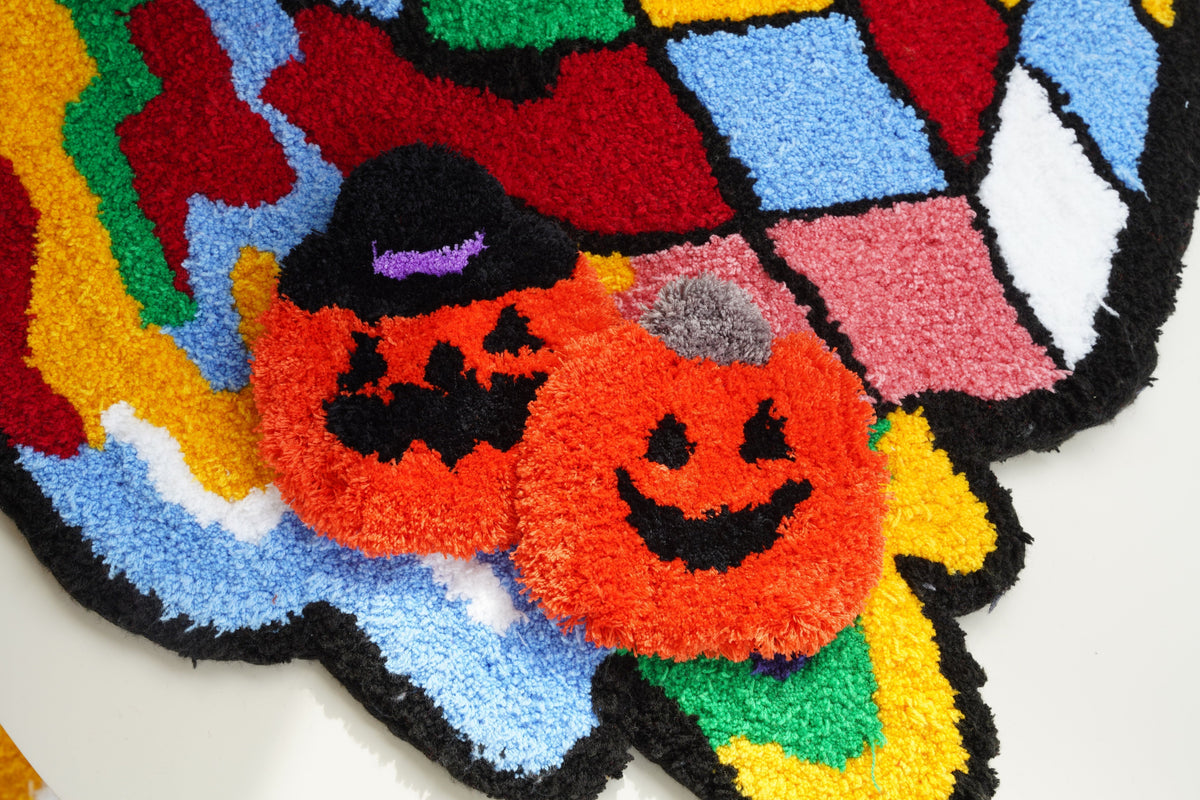
Ask a working tufter what sells and you'll get a shorter list than you expect. Not the pieces that took longest, and usually not the ones they'd put in a portfolio.
This is a look at what actually moves — by category, by size, by price, and by where it's sold.
The categories
Most tufted work falls into four physical categories. Personalised work is the exception: it isn't a size or a format but a type of order, and it cuts across all four.
Mid-size decorative pieces — 40 to 70 cm
Wall pieces, accent mats, door mats, shaped decorative work. This is the range most makers find their footing in.
Big enough to be a real object, small enough to ship without pain, quick enough that an unsold one isn't a disaster. It also photographs well, which matters more for online sales than most people expect. Most personalised orders land here too.
Small functional pieces — under 30 cm
Coasters, mug rugs, keyrings, small hanging shapes. Cheap in materials, easy to carry to a market, easy to buy on impulse. Volume is the point — nobody deliberates over a coaster.
Two things work against them. They face heavy competition from punch needle and macramé, which reach the same size with less equipment and less floor space. And the labour barely falls with the size: a coaster takes a fraction of the yarn but nearly the same setup, gluing and finishing as something four times larger. Most makers treat small pieces as a side product rather than the main business.
Large floor rugs — 90 cm and up
The highest prices and the slowest movement. A detailed 120 cm piece can easily mean 20+ hours of work, a serious materials bill, and shipping that gets awkward.
There's also a limit that isn't about money. A frame tied up for a week is a frame you can't use for anything else, so the real ceiling on large commissions is throughput, not demand. Made to order, large work can be good business. Made on spec, it puts a week of capacity into a single risky bet.
Functional hybrids
Framed mirror surrounds, chair pads, tote panels, cushion faces. These follow whatever format is having a moment, which cuts both ways: fast while the trend holds, dead stock after.
What decides whether they're worth chasing is how quickly you can test one. Trend windows are short, and finding out whether a format sells means putting a few versions in front of people while anyone still cares. If a single test piece costs you a weekend, you'll only ever test the formats you were already fairly sure about — which is the same as not testing.
Personalised work
Pet portraits, names, house numbers, wedding dates, business logos, gaming and streaming icons. Usually 40 to 60 cm, usually a single subject on a plain background.
This is one of the most reliable categories for a small tufting business. Buyers arrive with the request already formed — no persuasion needed, and much less price sensitivity, because there's nothing identical to compare against.
Logo work behaves differently again: businesses, studios and streamers buy rugs as branded pieces, on a business budget, and they tend to come back.
Price
There is no standard rate for tufted work. Among makers who price by area you'll see anything from $15 to $85 per square foot for rugs in roughly the same size range — a spread far too wide to treat as a benchmark.
Some of that is genuine difference. Wool costs more than acrylic. Dense carving takes hours that plain pile doesn't. A felt-and-rubber backing isn't a plain felt one. But none of it explains a gap that size.
Most of the rest is who the price was written for. A price set for marketplace browsers has to survive a grid full of cheaper thumbnails, including printed rugs photographed to look tufted. A price set for someone who came looking for a specific maker doesn't have to survive anything. Same rug, different conversation.
It's also true that tufted work is hard to judge from a photo. A buyer scrolling listings can't see a carved edge, can't see pile density, and has no reference for what forty hours looks like. Makers aren't much better placed — spend time in this craft's forums and you'll find people posting finished work and asking strangers what it's worth.
So the useful number isn't someone else's. It's your own costs, checked against the kind of buyer you're selling to. We've covered that arithmetic in how to price your handmade rugs.
Custom versus ready-made
Custom orders are sold before they're made. No unsold stock, and part of the money collected up front — a deposit of around 50% is common, particularly on larger pieces.
The cost isn't the tufting; it's the conversation. Mockups, revisions, chasing approval, explaining what tufting can and can't render at 50 cm. The most expensive variable is revisions: an order with no agreed limit can take more of your week than the making does. Custom enquiries also tend to die at one particular moment — the design is agreed, the deposit comes up, and the buyer disappears. That's an argument for naming a starting price early, not for skipping the deposit.
Ready-made is the mirror image. Nothing to manage, nothing to approve, and stock you can hand over on the spot or put on a table where people can touch it. What you give up is certainty: every finished piece is materials and labour sitting in storage until someone wants it. The risk moves from your calendar to your storeroom.
Semi-custom is where most working studios end up. A fixed set of designs the customer personalises within limits — choose the colours, add a name, pick from three sizes. It carries the pre-sale of custom work without the open-ended design process, and three defined options are easier for a customer to answer than an empty brief.
The model has one requirement: the fourth order in a design has to come out like the first. Semi-custom is a promise of repeatability, and if you can't keep it, the returns and remakes eat the margin that made it attractive.
Where it sells
| Channel | What it gives you | What it costs you |
|---|---|---|
| Marketplaces | Traffic and discovery | You're a thumbnail beside a thousand thumbnails, some of them printed rugs. Search rewards price. Easy to be found, hard to be chosen. |
| Markets and fairs | People can touch the work and see why it costs what it costs | Only lower-priced pieces move on the day. The real return is often the commissions that come later from people who met you. |
| DMs and word of mouth | Where a lot of custom work actually originates | Nothing scales. Someone who has decided they want something made wants to talk to a person. |
| Shops and consignment | Somewhere ready-made stock can live, in front of people who came to look at objects | Lower margin, and your work is out of your hands. |
What tends not to sell
Large speculative art pieces. Among the easiest work to end up sitting unsold. Weeks of work, a high asking price, deep discounts later — because the person who would have loved it wanted it in their colours, at their size.
Copyrighted characters. Beyond the legal exposure, it's a storefront that can be taken down rather than a body of work that's yours.
Too many directions at once. A shop with one of everything reads as a portfolio rather than a maker with a point of view.
Anything priced from materials alone. Costing the yarn and forgetting the twelve hours is a large part of why the low end of this market sits where it does.
Where to start
Two products rather than one.
An anchor piece — larger, more ambitious, more expensive. It rarely sells quickly, but it makes everything else look considered.
And a volume piece — small, repeatable, priced for an easy yes — for cash flow and first-time buyers.
Expecting one product to do both is the common mistake.
Before settling on a mix, though, look at what you can actually produce. The right category is partly a capacity decision. Personalised work needs enough throughput to take orders as they arrive rather than stacking them into a queue. Small pieces only earn their shelf space in quantity. Large commissions tie up a frame for a week at a time. And testing a trend format only works if being wrong is cheap.
Every category on this page has a capacity answer sitting behind it — which is worth knowing before you decide what kind of maker you're going to be.
Frequently asked questions
What tufted products sell best?
Personalised work — pet portraits, names and business logos — because the buyer arrives with the request already formed rather than browsing. Mid-size pieces between 40 and 70 cm are the strongest ready-made category.
What size tufted rug is easiest to sell?
Roughly 40 to 70 cm. Large enough to be a real object, small enough to ship affordably, and quick enough that an unsold one isn't a disaster.
How much do handmade tufted rugs sell for?
There's no standard rate. Among makers who price by area, you'll see anything from around $15 to $85 per square foot for rugs in roughly the same size range. Materials and finishing explain part of that; most of the rest is whether the price was set for someone browsing a marketplace or for someone who came looking for you.
Is it better to sell custom or ready-made?
Custom pays more and carries no unsold stock, but costs you time in design and revisions. Ready-made needs somewhere physical to be seen and ties up materials and labour until it finds a buyer. Most studios settle on semi-custom.
How many pieces should I make before I start selling?
There's no magic number. Start when you can reproduce your own work reliably enough to meet a customer's expectations — the point isn't volume, it's repeatability.
Should I take deposits on custom orders?
Yes, and agree the scope at the same time. Around 50% is common. Fix the size, the design and the number of revisions before you start — revisions with no limit are the most expensive part of custom work.
Share:
How to Price Your Handmade Rugs for 2026
Making Multiples: How to Tuft a Small Production Run for 2026