
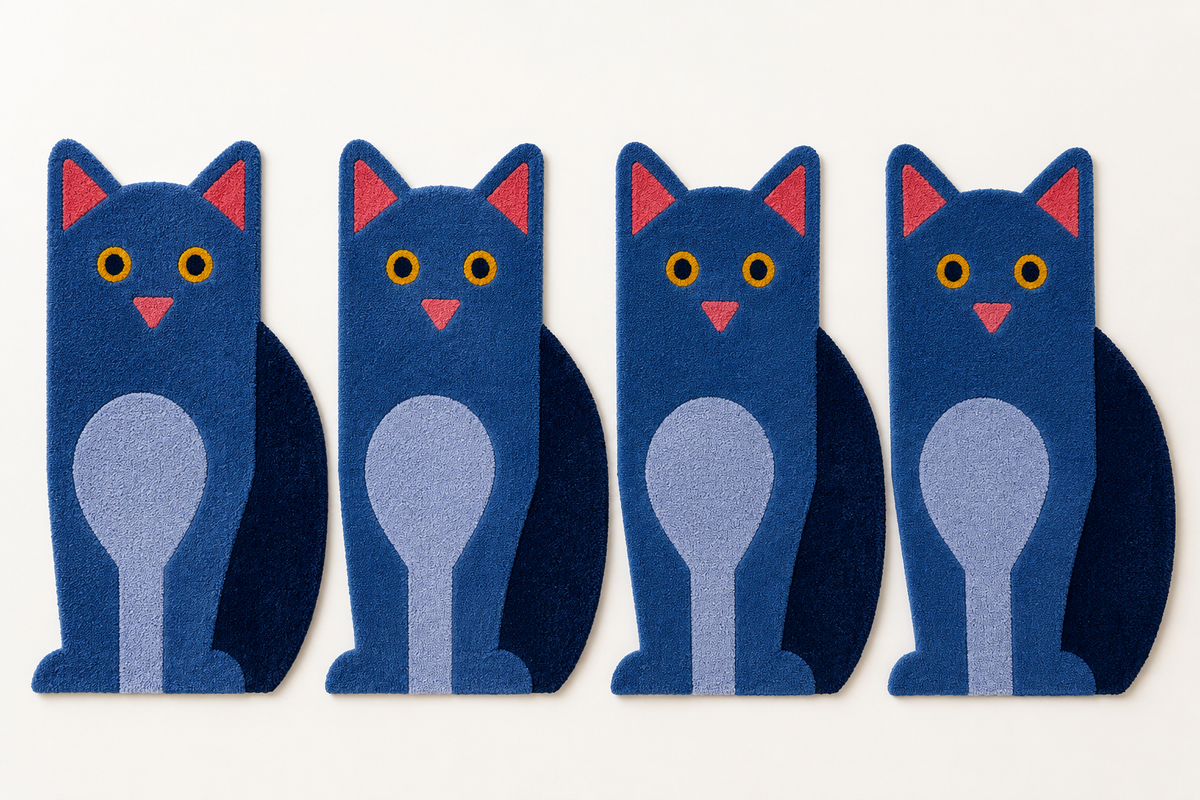
One rug is a piece of work. Twenty of the same rug is an order — and an order has to arrive looking like itself.
Making one, you solve problems as they come up. Making twenty, the same problem comes up twenty times: the yarn runs out at number fourteen, the new cone of red isn't quite the old red, the fourth rug doesn't look like the first.
If you sell semi-custom work, you've already promised those twenty will match — and a remake costs you full materials and full finishing out of the margin that made the order worth taking. What actually sells covers which designs are worth repeating. This is about how to repeat them.
1. Work out your materials from one piece
How much yarn a rug uses changes with the fibre, the yarn's thickness and construction, the pile height and how densely you tuft — which is why published averages are so wide. Get it wrong on one rug and you make a trip to the shop. Get it wrong on twenty and you either run short before the end or store the surplus for a year.
Tuft one piece and weigh the cones before and after, one colour at a time rather than all together. Time it. Note how much glue you used.
The per-colour weights are the ones you'll actually spend money on, because they tell you how many cones of each shade to buy.
Cloth works the other way round. It comes off the roll at a fixed width, and one small design leaves most of that width as scrap. Draw four copies across the same stretch and the scrap becomes four rugs. So cost the cloth from the length of roll the whole batch takes up, not from the piece you cut out for each rug.
2. Buy the run's yarn in one purchase — usually
Yarn is dyed in batches, and two batches carrying the same colour name can come out slightly different shades. Across a flat surface — which is what a rug is — that difference shows.
How much it matters depends on the fibre:
- Wool and other naturals: the variation is real. Buy once, and treat running short as a genuine problem rather than an errand.
- Solid acrylic: usually much smaller, though not small enough to ignore. You can buy in stages and keep the cash — twenty pieces' worth of yarn bought in August sits on the shelf until the pieces sell.
Either way, buy after the prototype, not before. Until you've tufted one, you don't know how the colours split.
And keep one cone of each colour back, labelled — because the reorder is where colour names fail. "Warm red" tells your supplier nothing, and three months later it tells you nothing either. That's why we numbered our yarn instead of naming it. Until your yarn carries numbers, buy one cone before you buy ten.
3. Batch the colour, not the piece
Batching saves you threading, not tufting.
A five-colour design tufted one rug at a time means five colour setups per rug — a hundred across a run of twenty. Do four rugs at a time and it's twenty-five. What doesn't change is the tufting itself: the same twenty rugs' worth of stitches, in whatever order you put them.
By hand, and when the frame is large enough, you stretch the cloth once, project and trace each copy onto it in turn, then work colour by colour across all of them. How many copies fit isn't only a question of area — you need to reach each one, spread glue on it, and cut it out afterwards.
A machine reads the path from a file instead. Copies that fit inside one working area go in as a single job rather than one at a time, and the yarn changes arrive in sequence instead of being decided at the frame.
4. Know how a run drifts
Mistakes get caught. What gets past you is drift — each piece slightly different from the last, none of them wrong, and number twenty clearly not from the same set as number one.
Four things let it in.
The yarn
One purchase, one labelled reference cone, numbers instead of colour names when you reorder.
The cloth
Same roll for the whole run, stretched to the same tension every time. Cloth that sits looser on the frame takes the needle differently.
The pattern
By hand, twenty traced outlines are twenty chances for the shape to drift. A machine reads the same path every time, so that variation goes — and any mistake in the path repeats just as faithfully. Where two colour blocks touch, the pile has to fit both colours into the same space, so the gap that keeps them apart has to be in the pattern before the run starts, not discovered at rug six. How an image becomes that file.
The hands
Carving is where your eye meets the rug, so carving drift is the kind people see. A rug carved at the end of a long day doesn't read like one carved fresh. Carve the run in one sitting where you can, with the same blades.
Buying once, using the same roll and running one pattern removes most of the variables. Your hands aren't one of them.
So finish one piece first, decide you're happy with it, and hang it where you can see it. Every rug after that gets held up against the object rather than against what you remember. It's also the reason to tuft the prototype on its own rather than inside the batch — working colour by colour, nothing is finished until nearly everything is.
5. Find where the queue actually forms
Gluing and curing look like the slow part. They aren't, quite. You glue the rug while it's still on the frame, so curing costs you the frame rather than your evening. That doesn't make it free: with one frame, the glue decides when the next batch can start.
What backs up is finishing — levelling, carving, backing, edges, binding, everything rug finishing covers. Carving is the part that won't compress, because you do it one rug at a time by hand and twenty rugs don't make your scissors faster. On a small piece that's hours, not minutes.
Which is why you stagger a run — pieces one through six drying while seven is on the frame. By hand you can't tuft piece eight while you carve piece six. You do one, then the other, and the hours add instead of overlapping.
A machine doesn't remove either job. It removes the taking turns. The frame keeps tufting while your hands stay on the carving table — which is the real reason a run gets faster, and it has nothing to do with stitches per minute.
A run in order
- Tuft one prototype on its own. Weigh the yarn colour by colour, time it, note the glue.
- Finish it completely and decide you're happy. This becomes your reference object.
- Buy the materials — yarn from the prototype's weights plus a margin, cloth costed by roll length for the whole batch.
- Fix the pattern before the run starts, including the gaps between colour blocks.
- Batch by colour, as many copies per stretch as you can reach and cut.
- Stagger tufting and finishing so the frame and your hands are never waiting on each other.
- Carve against the reference, in one sitting where possible, with the same blades.
Frequently asked questions
How many pieces count as a production run?
There's no universal number. In practice it starts at the point where you're buying yarn by the cone and glue by the tub — several copies of the same design, made to the same specification.
How much yarn do I need for a batch?
Weigh what one prototype used, colour by colour, multiply by the run, and add a margin. Published averages vary with fibre, yarn construction, pile height and density, so use them as a sanity check rather than as your buying figure.
Do I really need to worry about dye lots?
It depends on the yarn. Natural fibres can vary noticeably between dye batches, so buying a wool run in one go is worth doing. Solid acrylic usually varies less, which makes staged purchases practical. Keep a labelled reference cone either way, so you have something to match against when you reorder.
Can I run a batch with a tufting gun?
Yes. Stretch a frame large enough for several copies, leave room to work around each one, and go colour by colour across the batch. Consistency still depends on the operator, which makes a finished reference piece especially useful.
What's the most common mistake on a first run?
Starting the batch before finishing a prototype. Without a completed reference piece you're matching twenty rugs against a memory, and you won't find out whether the design actually works until most of the materials are already committed.
Should I charge less for pieces in a run?
Not automatically. Each piece still uses full materials and needs the same finishing. If batching reduces your time per piece, that can improve your margin rather than become a discount. How to price the work is covered here.

Share:
What Actually Sells in 2026: A Look at Tufted Work That Moves
Custom Pet Portrait Rugs for 2026: How They're Made and What to Charge