
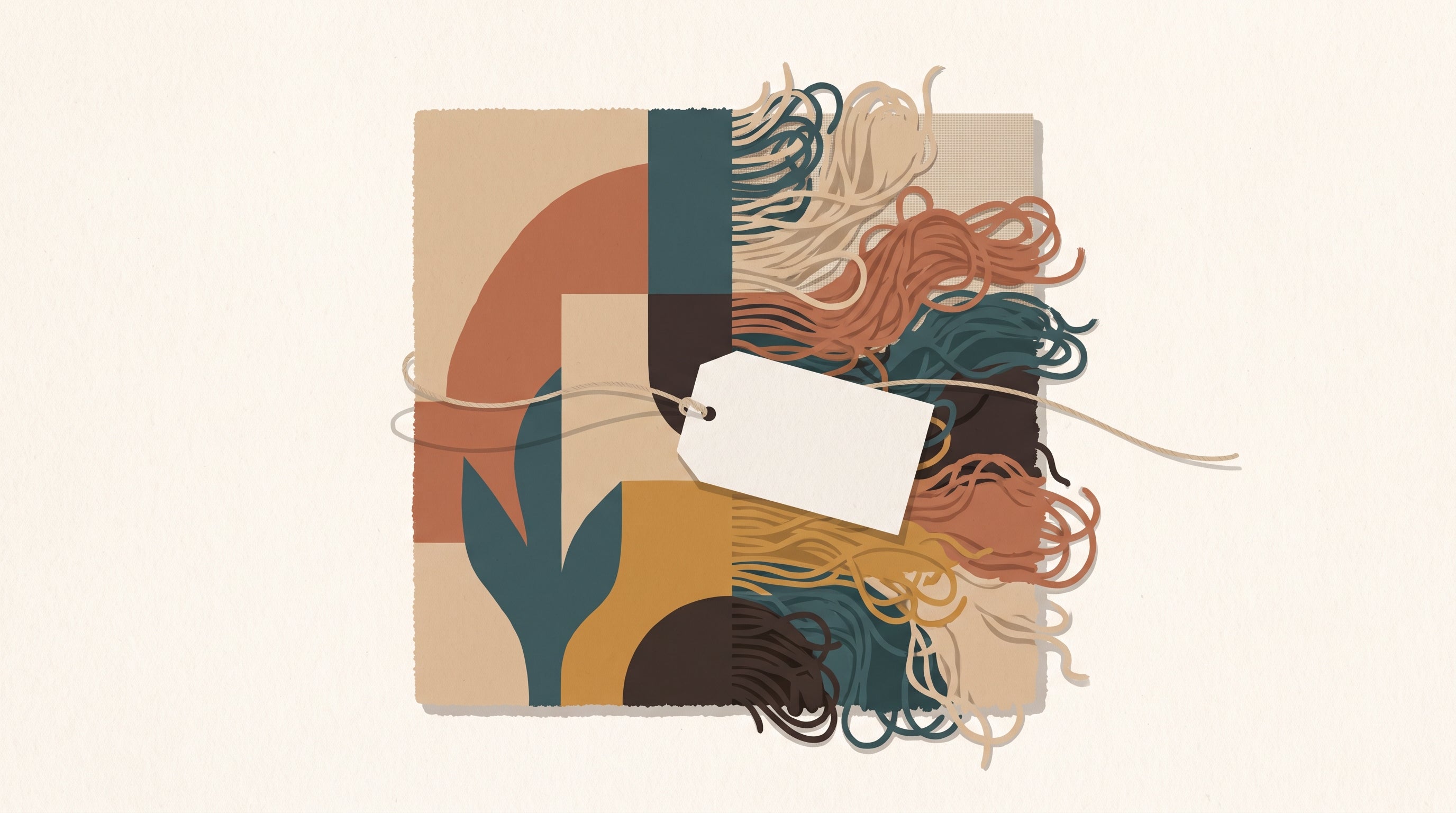
There's a question underneath the pricing question, and it's the one that actually decides your number: what part of this rug is the customer paying for?
Not the yarn. Not the hours. Those are your costs, and costs only tell you the floor. What people pay above the floor, they pay for the part of the rug that could only have come from you.
Which is worth being clear about before we get to arithmetic — because the single most common pricing mistake in this craft is charging for the wrong half of the work.
The two halves of a rug
Every tufted rug is made of two kinds of work.
Judgement — deciding what the piece should be. Cropping the photo so the dog's face fills the frame. Knowing that six colours will read and eleven will turn to mud. Seeing that the design needs a carved edge to stop looking flat. Understanding what a client is actually asking for when they say "something warm."
Execution — the repetition that turns that decision into an object. Row after row, holding the same angle, at the same pace, for hours.
Customers pay for the first. They tolerate the second because, until now, it came attached.
Nobody has ever paid extra because a rug took you twenty hours instead of five. They pay because the rug is the one they wanted and nobody else was going to make it. The hours were never the value — they were the toll.
Keep that distinction in mind through everything below, because it's what stops automation from turning into a discount.
The five factors
Five things set the price of a tufted rug: materials, size, complexity, your time, and what the market will pay. Four of the five shift once the tufting is automated. Here's what each does, and which way it moves.
1. Materials — your floor
Yarn, cloth, glue, backing, hem tape. Add them up per rug rather than per season, and remember cloth comes off a roll at a fixed width: a small design still uses a full width, and the off-cut is part of that rug's cost.
Material quality is a pricing decision, not just a cost. Wool over acrylic, felt-and-rubber backing over plain felt — both raise your costs, and both give you a reason to charge more.
Automation changes nothing here. No machine makes yarn cheaper or saves you a drop of glue. Every rug costs what its materials cost, whoever laid the yarn down.
2. Size — grows faster than it looks
Area climbs faster than the tape measure suggests. A 70 × 70 cm rug isn't 40% bigger than a 50 × 50 — it's nearly twice the area(more on picking a working width here), so roughly twice the yarn and twice the tufting.
But setup, gluing, photographing and packing barely change between the two. Which is why a flat per-square-foot rate leaves you undercharging for small rugs: the parts that don't scale get spread thinner the larger you go.
With a machine, most of what size adds moves off your hours and into machine time and yarn. Not all of it — a larger piece still means more yarn swaps, more surface to level, more edge to carve. What changes is where the cost sits: more in materials, less in your labour.
3. Complexity — where the craft actually lives
By hand, this is where price should climb hardest. Seven colours and fine shapes against two colours and simple blocks are not the same job at the same size.
Automation splits this factor cleanly in two, and the split is the whole argument of this article:
- The execution side collapses. A circle and a portrait can take similar machine time to tuft. A colour change becomes a pause and a swap rather than an afternoon of concentration.
- The judgement side doesn't move at all. That portrait still has to be designed — simplified, recoloured, scaled so it reads at floor level. Every colour boundary is still an edge you carve by hand. A busy design still takes longer to finish than a plain one.
So a machine owner charges for complexity differently, not less: less for the number of colours, more for the design and the carving. Which is a more honest way to price it, because it charges for the part that was actually hard.
4. Your time — count the whole job
Design and colour decisions at the front. Gluing, hemming, backing, levelling and carving at the back. On a small piece, finishing can take as long as tufting or longer — and it's the part that decides whether a rug reads as handmade or homemade.
Curing is the exception: it takes up to a day and none of it is yours. That belongs in your lead time, not your invoice.
This is the factor a machine changes most. The tufting hours largely stop being your hours. What's left is setup, the swaps, and the finishing you were doing anyway.
And it changes which rugs are worth making. Cheap pieces rarely pay by hand, because the hours won't shrink to fit the price. Take the tufting hours out — and lay several small designs into one frame so a single yarn swap serves all of them — and the low end starts paying for itself.
5. What the market will pay — the only factor above the arithmetic
The other four are your costs. This one is the market's opinion, and it's the only thing that can carry a price above what the sums say.
A design people ask for repeatedly is worth more than one you had to talk someone into. A rug in a gallery is worth more than the same rug on a market stall. A commission from someone who came looking for handmade work is worth more than a passing sale.
None of that is about how the yarn got into the cloth. It's about whose idea it was.
And this is where automation earns its price rather than discounting it. By hand, a popular design is demand you can't supply — you turn work away, or you spend a month repeating yourself. From a file, the tenth comes out like the first. Popularity turns into a product line instead of a queue.
Why consistency is worth money too
One thing that rarely makes it onto pricing lists: being able to promise a result is itself worth charging for.
A client ordering a $400 custom piece isn't only buying a rug. They're buying the confidence that it will look like the mockup, that the second one will match the first, that the set of four cushions will actually be a set. By hand, every one of those promises carries risk — and experienced makers quietly price that risk in, or avoid the orders that carry it.
Consistent execution removes the risk without removing the authorship. The design is still yours. The colours are still your call. The carving is still your hand. What's gone is the chance that rug three comes out visibly worse than rug one.
That's not a reason to charge less. It's what lets you take on the work that pays most: repeat orders, matched sets, corporate commissions, anything where "it'll be roughly like the last one" isn't an acceptable answer.
Turning the five into a number
- Cost the materials for this rug. Yarn, cloth, glue, backing, everything — including the cloth off-cut. You paid for it.
- Time the whole job. Design, tufting, finishing, packing. Do one rug properly rather than guessing. Curing doesn't count; you're not working during it.
- Set your hourly rate first. Otherwise you'll work backwards from a price you're afraid to charge.
- Add overhead. Equipment, blades, electricity, payment fees, packaging, and the pieces that never reach a customer. Spread it across what you realistically expect to make.
- Add profit. Your rate pays you for the work. Profit is what covers mistakes, refunds, the next machine, or a shop taking its cut.
- Then check the market. If your price sits above what your buyers will pay, change the rug before you change your rate — smaller, simpler, or faster to produce.
After a few rugs you'll have your own per-square-foot number, based on what your work actually costs rather than what someone else charges.
The five factors, side by side
| Factor | By hand | With the tufting automated |
|---|---|---|
| Materials | Sets your floor | Unchanged |
| Size | More materials, more of your hours | More materials and machine time; setup and finishing stay yours |
| Complexity | Costs labour heavily | Costs machine time to tuft; still costs your labour to design and carve |
| Your hours | Tufting is the major share | Tufting comes off your plate; finishing does not |
| Demand | Popular work is capped by your capacity | Popular work becomes repeatable |
Read down the right-hand column and it isn't five changes — it's one. Your labour stops being proportional to every rug. The execution scales; the judgement doesn't, because it never could. That's the actual economic shift, and it's a bigger one than "the tufting is faster."
So what are you charging for?
The same thing you always were.
A machine doesn't make your rugs less yours. It doesn't choose the image, the palette, the crop, the depth of the carve, or which client you say yes to. It removes the toll between the idea and the object — and the toll was never what anyone was paying for.
What changes isn't the value of your work. It's how much of your week you spend earning it.
Know what a rug costs you before you look at anyone else's price. Then let the market tell you whether you're selling to the right customer.
Frequently asked questions
How much should a hand-tufted rug sell for?
Typically around $100–$300. Small, simple pieces come in below that; larger or highly detailed custom rugs often reach $300–$1,000 or more.
Does using a machine mean I should charge less?
No — and this is the most expensive assumption a maker can make. Materials and finishing cost the same. The design work costs the same. What you've saved is repetitive execution, which nobody was paying a premium for in the first place. The hours you get back can just as reasonably become higher profit, or more rugs, as a lower price.
Should I tell customers the tufting is automated?
Yes, and it's easier to talk about than people expect. The honest framing is also the accurate one: the machine lays the yarn, you design the piece and finish it by hand. Buyers who care about authorship care about who made the decisions — and that answer doesn't change.
What if I have to remake a rug?
That cost belongs to the business. Track failed pieces, wasted materials and rework as overhead rather than pretending they didn't happen.
Should I take a deposit for a custom order?
Yes. A deposit covers materials and some of your time before you start. For custom work, agree on size, design and number of revisions before taking the order.
Share:
What Actually Sells in 2026: A Look at Tufted Work That Moves