
Walk into any yarn shop and every label is answering someone else's question.
Recommended needle size. Gauge over four inches. Wraps per inch. All of it is written for people who knit, and none of it tells you the one thing you actually need to know: will this run through my machine?
That gap is why choosing yarn feels harder than it is. You aren't missing knowledge — you're reading a system that was never pointed at your problem.
So let's skip the decoding. Here's what your machine cares about, how to test any yarn in about a minute, and what the labels mean once you no longer need them to make the decision.
Your machine asks one question about yarn
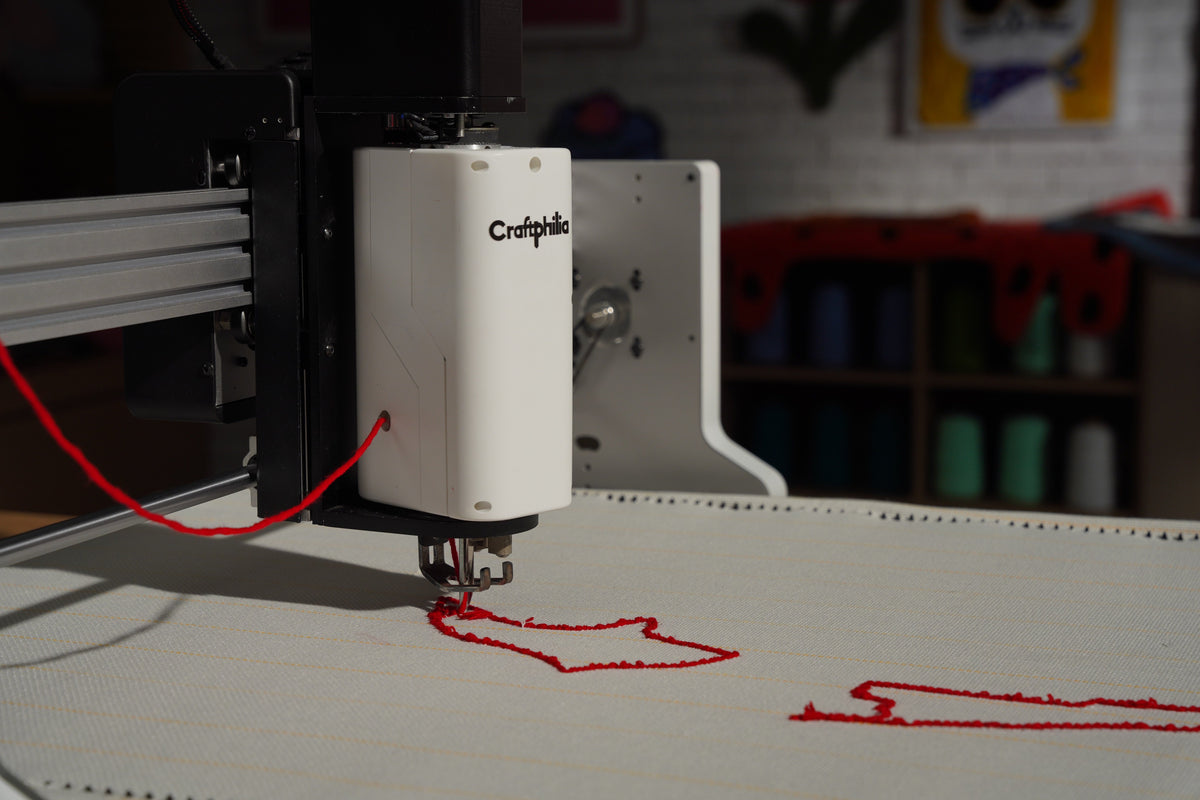
Craftphilia machines are built around yarn up to 5 mm. That's the whole specification. Anything within it feeds and cuts the way it should.
Fibre isn't part of that question. Acrylic, wool, cotton and blends all run. Yarn from other brands runs too, as long as it stays inside the same limit — there's no proprietary spool and no lock.
Everything after this is about the rug you want, not about whether the machine will cooperate.
Fill the needle, then adjust the settings
The test that matters happens at the needle, not on the label.
Thread the yarn and look at how it sits. The needle eye should be filled — snug, with the yarn still moving freely when you pull it through by hand. That's the target state, and you can see it without measuring anything.
From there:
- Yarn drags, catches or resists when you pull it through — too thick. Move to a finer yarn.
- Yarn sits loose and the pile comes out sparse, with backing visible between rows — too thin, though this is more often a settings problem than a yarn problem.
That second case is where a machine differs from a tufting gun. With a gun, thin yarn gets solved by threading two or three strands at once. Here, 3-ply, 4-ply and 8-ply yarns all run, and a finer yarn is brought up to a full pile by adjusting speed and row spacing in the software instead. Feeding two strands at once is possible as well, but it uses the Dual Spool Tray — a separate accessory rather than something you improvise at the needle.
Run a small patch before committing to a full design. Ten minutes of tufting tells you more than any specification sheet.
Material decides how the rug lives, not whether it runs
Since the machine accepts all of them, fibre becomes a design decision. It shapes how the finished piece looks, feels and ages.
- Acrylic is the default for good reason: the widest colour range, the lowest price, and it holds a carved edge well. It's what most tufted work you've seen is made from.
- Wool springs back. Press your hand into a wool pile and it recovers; press into acrylic and the mark lingers longer. It costs more and the colour range is narrower, but it's often the choice when softness and resilience matter.
- Cotton has a flat, matte surface that suits quieter palettes and vintage-leaning designs. It's denser to carve, so detailed work takes more patience.
For a simple starting point, we recommend an 8-ply milk cotton. It sits comfortably within the specification and gives a good balance of tufting quality and machine performance.
The yarn that came with your machine is your reference
Your machine ships with yarn, and that yarn is already inside the specification. Keep some of it.
It gives you something no chart can: a physical reference. Hold a new yarn next to it, roll both between your fingers, and you'll feel a difference no label would have told you about. Noticeably thinner means you'll be leaning on the software settings. Noticeably thicker is the one to be careful with.
This is the fastest answer to "will this work" that exists, and it needs no units at all.
How to read a yarn label
You'll still meet labels, so here's the short version.
North American yarn is often marked Medium, #4 or Worsted. They point to roughly the same range of thickness, which is a useful place to start for tufting. European and supply-side yarn is often labelled in tex instead — a unit of thickness rather than a category. Higher tex, thicker yarn.
Neither system was designed to predict how yarn behaves in a tufting needle. Read them to narrow your options, then test.
The colour problem nobody has solved yet
Thickness you can test in a minute. Colour is the harder one, and it isn't a software problem — it's a gap in the craft itself.
Tufting has no shared colour language. You can't tell another maker which red you used and have them find it. You can't hand a client a number. You can't look at a design on screen and know which cone to order — you hold up a photo next to a shelf and guess. Knitting has systems for this. Paint has Pantone. Tufting has eyes and hope.
We're building a numbered colour system to close that gap, so that every colour in a design maps to a real, numbered yarn and the software can simply tell you what to buy. More on it when there's something to show.
What we'll say now is how we intend it to work: not as a private catalogue. A numbering system that only describes our own yarn wouldn't be a standard, it would be a product list — and the craft doesn't need another one of those. It's worth doing only if it becomes something the whole craft can use, whatever machine or gun is doing the tufting, and whoever spun the yarn.
If you have a view on what that should look like, our community group is where that conversation is happening.
Buy one cone before you buy ten
The last step is the one people skip, and it's the only one we'd call a rule.
Buy a single cone or skein of anything new. Tuft a patch. Look at the coverage, shear it, see how it carves. Then order the rest — from the same dye lot, since the same colour spun in a different batch can shift enough to show as a seam across a finished piece.
Choosing yarn isn't something you get right by reading. It's something you get right by testing once, cheaply, before it matters.
Frequently asked questions
Does my yarn need to be on a cone?
It needs a hollow core. Yarn on a standard spool or cone drops straight onto the yarn holder and needs no preparation. Yarn sold as a hand-wound ball or a centre-pull skein has nothing to sit on, so wind it onto an empty cone first. Worth checking before you order — it's the one packaging detail that decides whether yarn is ready to use out of the bag.
How do I know which yarn matches the colours in my design?
Right now, by eye. Design tools can flatten an image into six clean colours, but those are screen values, and nothing currently connects them to a cone you can buy. That's the gap the numbered colour system above is meant to close.
How much yarn will I need?
As a working figure, a fully tufted piece takes roughly 2.5–3 kg of yarn per square metre. Pile height, density and how much of the frame your design actually covers all move the number, so treat it as a starting estimate and buy a margin on your main colour.
What's the difference between ply and strands?
Ply is built into the yarn at the mill: an 8-ply yarn is one yarn spun from eight finer ones, and you buy it as a single strand. Feeding two strands means running two separate yarns off two spools through the same needle. Ply describes the yarn you bought; strand count is the part you control — and on a Craftphilia machine that second one needs the Dual Spool Tray, sold separately.
Do I have to use Craftphilia yarn?
No. The machines are built around a 5 mm yarn specification rather than a single material — acrylic, wool and cotton all work, and third-party yarn in that spec is fine. We recommend our own because we've tested it, and yarn outside the spec that damages the machine isn't covered by warranty.
Can I use the same yarn with a tufting gun?
Yes, and most of this guide applies either way. The needle test, the dye lot rule and the fibre differences are the same whatever tool you're using — the only machine-specific part is how thin yarn gets compensated for, in software rather than by threading extra strands. Compare tufting machine with gun.

Share:
How to Carve Clean Edges in a Tufted Rug
Tufting Has No Colour Language. We're Building One