
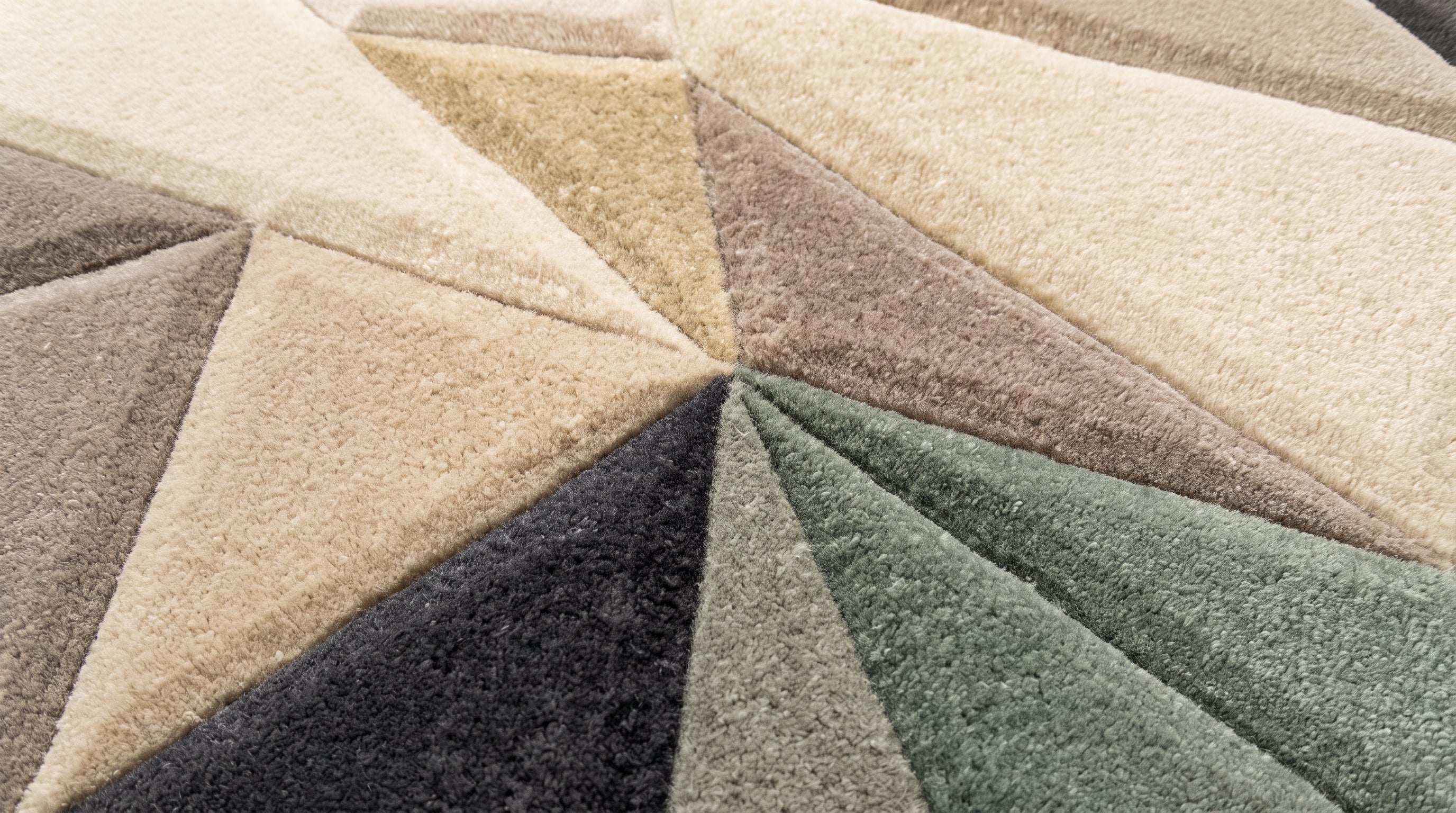
You levelled the pile, took the scissors to the outline, and the edge still reads soft.
Nothing you did was wrong. Levelling and edging are two different cuts, and most people aim the second one at the wrong place.
A clean edge is a shadow, not a line
Pile has no edge of its own.
Yarn ends are soft and they lean. Where two colour blocks meet, the taller side tips over the shorter one, the two colours interleave across a few millimetres, and the boundary you drew reads as a smudge. That happens whichever tool put the yarn into the cloth — a gun, a machine, a hand hook.
Which is why the usual advice misses. Level the surface, then trim carefully along the colour line — cut it perfectly and it still reads soft, because the yarn on both sides is standing at the same height and still leaning.
What reads as sharp is a change in depth. Take material out along the boundary and you get a groove. The groove holds a shadow. The shadow is the line your eye is actually seeing.
What you need to carve with
The two finishing passes are different, and different tools suit each:
- An electric trimmer or carpet shaver for the levelling pass — flat, fast, no judgement required.
- A pair of carving scissors for the edges — held at an angle, doing all the judgement.
Both are standard tufting tools rather than anything proprietary, sold wherever the rest of your supplies are. Neither comes with the machine, and a shaver you already own works exactly as well as one with our name on it.
Levelling comes first
Level the pile before you carve. Do it the other way round and the levelling pass cuts away the carving you've already done.
Levelling is the flat pass. Trimmer held parallel to the surface, worked across the whole piece, bringing the pile to one height. Nothing delicate at this stage.
Carving is a different posture. Blade tilted, one boundary at a time.
Both passes sit after gluing and drying — that stage has its own post, and it's the one to read first if you haven't done it.
Cut down, not across
The cut that makes an edge goes into the pile, not across the top of it.
- Tilt the scissors to roughly 45 degrees.
- Work toward the colour boundary rather than along it, cutting a V-shaped channel down into the seam between the two blocks — shaving the top and the sides of the pile, stopping short of the base cloth.
- Work in short passes rather than one long one.
- Then step back. Up close you're looking at yarn; from two metres away you're looking at the shadow — which is the view the rug actually gets seen from.
You're cutting the walls of the yarn, not the tips. A flat cut leaves two blocks at one height with a soft join. An angled cut leaves two blocks with a valley between them, and the valley was the point.
Depth decides how sharp the edge reads
How dark that shadow sits depends on how deep the groove goes.
Craftphilia tufts at a fixed pile height of 14–16 mm before trimming, and that number is your budget. Levelling spends some of it. What's left is what you have to carve into.
Deeper groove, heavier shadow, harder edge. The floor is the base cloth: cut down to it and the groove stops being a shadow and starts being a hole, with backing showing through. You stop somewhere above that, and where exactly is a judgement you make on the piece in front of you.
There's no setting for any of this. Pile height isn't adjustable in the software and doesn't vary within a design — dimensional variation in a finished piece is created at the carving stage, not during tufting. Worth knowing before you plan a piece around dramatic level changes. The machine gives you one height and a clean colour separation; the relief is cut afterwards.
Curves and corners take a different cut
A curve is where one fixed blade angle stops working.
On a straight boundary you can hold the scissors at one attitude and walk them along. On a curve the boundary keeps turning under the blade, so the angle has to turn with it — shorter passes, wrist rotating, checking more often.
Inside corners are the tight ones. The blades struggle to get their full width into the angle, so the groove shallows out at exactly the point where two boundaries meet — and a shallow groove there reads as a rounded corner even when the tufting underneath is square. Small detail scissors give you more control on the final cleanup.
Size sets a floor under all of it. Around 10 mm is the smallest structural unit we'd suggest for a circular area; finer single-line paths are possible depending on your settings and yarn.
Does an automated machine give you cleaner edges?
Not by itself.
What it gives you is a colour boundary in the right place, repeated the same way every time. Our published figure is 0.5 mm positioning accuracy — and that describes where the yarn goes, not how the finished edge reads.
Between the two sits a layer of soft material that path precision doesn't reach on its own. The final look still depends on yarn thickness, density and how the material behaves, and that's true across every tufting method.
So: the machine puts the boundary in the right place. The shadow over it is still cut by hand.
The edge was decided before you picked up the scissors
How clean an edge can get was largely settled while the design was still on screen.
Colour separation. Two shades close enough to read as one become a boundary with nothing to carve — cut a groove and both walls look the same, so the shadow has no job to do. Merging them, or swapping one for a yarn that actually contrasts, is a decision made in software rather than at the frame.
Block size. Detail thinner than about 10 mm has nowhere to go once it's yarn, and less than nowhere once you're cutting a V into both sides of it. Deciding that at real size — in millimetres, against the piece you're actually making — is cheaper than finding out with scissors in your hand.
Density. How much material ends up under the blade is adjustable in software, so it's a design-stage decision rather than something you discover at the frame. A Dual Spool Tray runs two strands into the same path where your yarn is fine enough to take it.
None of it is glamorous, and all of it is why the piece you're carving either cooperates or doesn't. Craftphilia Studio handles the colour separation, the real-size sizing and the path work — and it's free whether or not there's a machine on your table.
The scissors finish an edge. They don't decide it.
Frequently asked questions
Can I fix a groove that went too deep?
Not completely — once pile is cut away you can't put that height back. If backing is showing through, you can sometimes tease the yarn on either side toward the gap and blend the surrounding pile, which makes it less noticeable without restoring the depth. The easiest way to avoid it: start shallower than you think you need. You can always take another pass.
Should I carve on the frame or off it?
Either works. The frame slides in and out of the machine and the piece comes out with the frame still attached, so you can carve while the fabric stays under tension. Leaving it on the machine for the follow-up work is fine too.
Can I carve with scissors alone?
Yes — the carving pass is scissors work regardless. It's the levelling pass where you'll feel the lack of a trimmer, since holding a large piece to a consistent height by hand is hard.
How long does carving take?
It depends on the size of the rug, the number of colour boundaries and how much definition you want — a quick cleanup on a simple piece, a substantial part of the finishing work on a detailed one. Most of the time isn't spent making each cut; it's spent repositioning, checking the shadow and deciding where to stop. For a first rug, expect it to take longer than it looks.
Do different yarn types carve differently?
Yes. Thinner or softer yarn gives you less structure at the cut, which can make an edge look softer even when the groove depth is right. The guidance here assumes 5 mm yarn, which is what the machines are built around.
Does carving remove the need for finishing the back?
No. Carving is surface work — gluing, curing and backing are separate steps and come first. Carving a piece that hasn't been properly glued will pull yarn out.
Share:
Can you use Craftphilia Studio if you don't own a Craftphilia machine?
Choosing Yarn for Tufting: Weight, Material and What Matters