
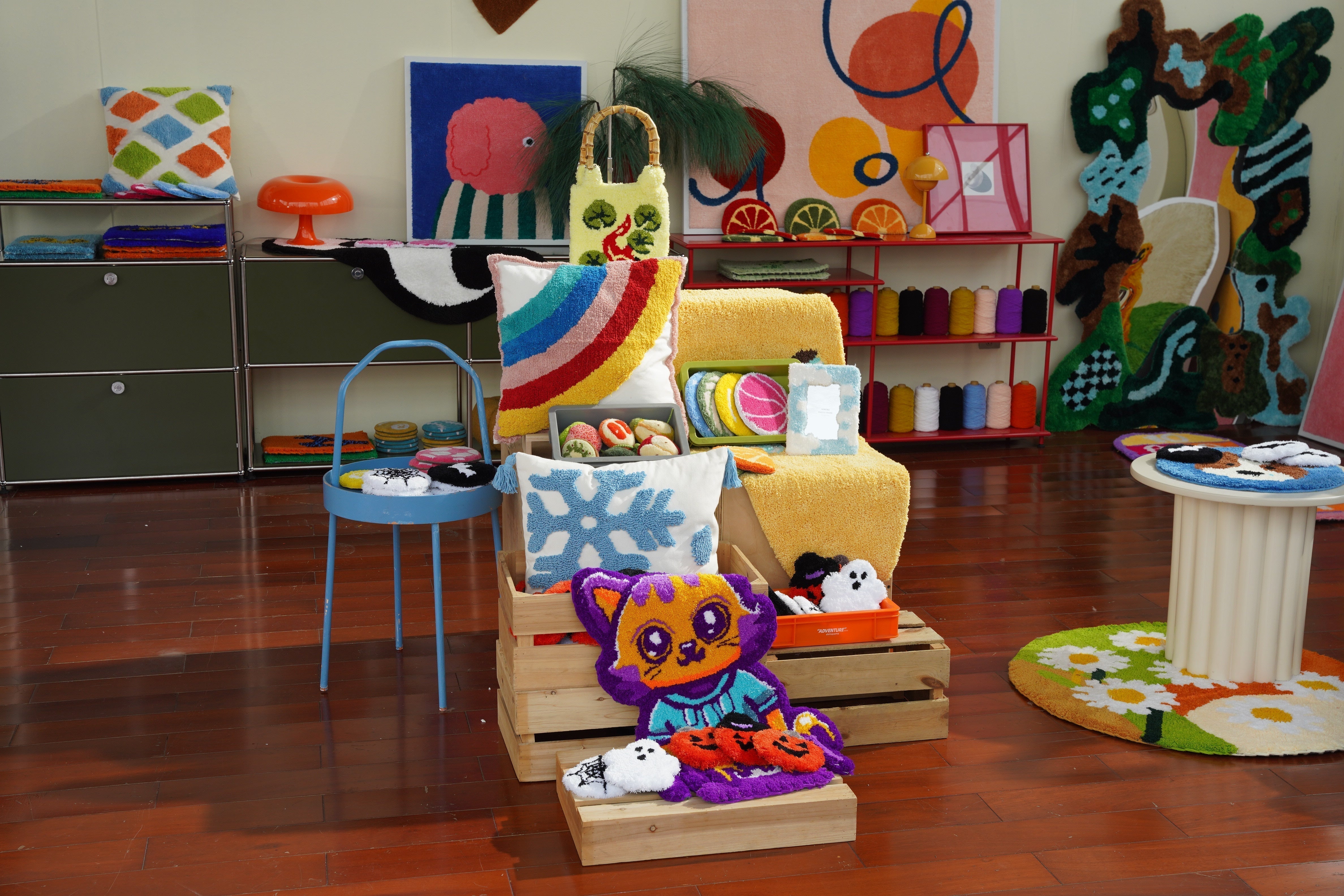
You have to pick a size before you've made a single rug. That's the awkward part.
The question everyone starts with is how big do I want to go, and it's the one that leaves people stuck longest — because nobody knows what they'll be tufting in six months when the first piece isn't finished yet.
Three things actually decide it: the table you'll put the machine on, the width you'll be working at most weeks, and the length you can add later. Take them in that order and the answer arrives on its own.
What the two sizes give you
The CF05 tufts within 500 × 500 mm. The CF07 within 700 × 700 mm.
Those figures are the tufting area itself. The cloth you stretch is cut larger, so there's material to grip at the edges — but your design runs to all four sides of the stated number. That matters more than it sounds: you can hold these figures against a finished rug you like and compare directly, rather than discovering later that the usable area is smaller than the frame.
| CF05 | CF07 | |
|---|---|---|
| Tufting area | 500 × 500 mm | 700 × 700 mm |
| With Expansion Kit | 500 × 1000 mm | 700 × 1400 mm |
| Machine size | 850 × 720 × 450 mm | 1050 × 920 × 450 mm |
| Size with Expansion Kit | 850 × 1220 × 450 mm | 1050 × 1620 × 450 mm |
| Weight | 17 kg (20 kg with Kit) | 19 kg (23 kg with Kit) |
| Price | $X | $X |
Everything else is identical: same software, same stitch mechanism, same speed, same 14–16 mm pile. What separates them is $X and a width.
1. Measure the table before anything else
The commonest sizing mistake is measuring your table against the tufting area. The machine is bigger than the rug it makes. A CF05 with a 500 × 500 mm working area is an 850 × 720 mm object sitting on your desk. A CF07 is 1050 × 920 mm.
Fitting the Expansion Kit means undoing and resecuring a few screws on the base and frame. Most owners do it once and leave the machine that way — so the footprint to plan around is the expanded one: 850 × 1220 mm for a CF05, 1050 × 1620 mm for a CF07.
An expanded CF05 sits on a standard desk or a folding work table. An expanded CF07 wants a dedicated surface — a long workbench, a kitchen island, a table you're not also eating at.
Three more numbers belong in the same measurement:
- Height. Both machines stand 450 mm tall. A shelf above the work surface needs that much clearance.
- Weight. 17 kg for a CF05, or 20 kg with the Kit fitted. 19 kg for a CF07, or 23 kg. The table has to hold that without wobble.
- Overhang. A little at the front or back is fine as long as the surface is level and the machine sits stable. Full support is still the better setup.
Do this measurement first. It's the one constraint that doesn't care what you plan to make.
2. Pick your width from what you make most weeks
The largest piece you can picture is usually a one-off. What the machine really sets is the shape of an ordinary week — the piece you start before work, the batch for a market stall, the gift you turn around in an afternoon.
Tufted work clusters into a handful of familiar formats, and each one carries a width:
| Format | Typical width | Fits |
|---|---|---|
| Coasters and mug rugs | 100 – 200 mm | Both |
| Patches and small wall art | 300 – 500 mm | Both |
| Doormats | around 450 mm | Both |
| Bath mats | 500 – 600 mm | CF05 at the low end, CF07 throughout |
| Bedside pieces and runners | 600 – 700 mm | CF07 |
Those widths come from where the objects end up. A patch sits on a jacket. A doormat fits a threshold. A bath mat spans the front of a tub. A runner runs beside a bed. If you've never tufted and can't picture your own sizes yet, that list stands in for experience — find the formats you keep coming back to and read off the width.
Note where the 500 mm line falls. It covers coasters, patches, wall art, doormats and the smaller bath mats. Above it sit larger bath mats, bedside pieces and runners.
3. Length is something you can add later
An Expansion Kit doubles the length of either machine: 500 × 1000 mm for the CF05, 700 × 1400 mm for the CF07. That 700 × 1400 mm is the largest working area our current lineup supports — beyond it, oversized work is made the way tufters have always made it, in panels joined after finishing.
Each Kit is built for its own machine. The CF05's Kit extends a CF05 to 1000 mm; the CF07's extends a CF07 to 1400 mm. Frames and Kits don't cross between models.
Which gives you the shape of the decision: length is something you can add whenever a project calls for it. Width is the part you settle at the start.
The argument for the wider frame, even if your work is small
This is the part most people don't see coming, and for some makers it decides the whole question.
Craftphilia Studio lets you lay several small designs into a single working area and run them in one session. If your work runs small — patches, coasters, a set of matching wall pieces — this is how you'll use the machine most of the time. Lay four or six designs across the frame, send the job once, and the machine works through them together.
The payoff is in the colour changes. Each yarn swap then serves every piece on the frame at once, instead of being repeated per item — and repeating them per item is usually what eats the afternoon. A wider frame doesn't just make bigger rugs. It makes more small ones per session.
So: CF05 or CF07?
Choose the CF05 if most of what you have in mind sits at 500 mm or under — wall art, patches, doormats, coaster sets, small accent rugs. It covers all of that for $150 less and takes up noticeably less table. Adding the Expansion Kit from the start means length is never the thing that stops a project.
Choose the CF07 if 600–700 mm keeps showing up in your plans: runners, larger bath mats, big single-panel wall pieces, or client work where the brief arrives before the dimensions do. A CF07 runs small designs inside its frame just as happily, so the wider default closes nothing off — and it fits more of them per session.
Both machines make rugs up to the full length their Expansion Kit allows. What you're really choosing here is the width of an ordinary working week.
New to automated tufting? Start with The Complete Guide to Automated Tufting Machines.
Frequently asked questions
Does the whole machine have to fit on the table?
Not strictly — a slight overhang at the front or back is fine as long as the machine is level and stable, though full support is always the safer setup. Measure against the machine size rather than the tufting area: a CF05 with a 500 × 500 mm working area is 850 × 720 × 450 mm overall, and 850 × 1220 × 450 mm with the Expansion Kit fitted.
Can I use a CF07 frame or Expansion Kit on a CF05?
No. The two models use different frame sizes and aren't cross-compatible — each machine works with its own frame and its own Kit. A CF07 can tuft smaller pieces inside its frame, but a CF05 can't take the larger one. Working at both widths means two machines.
What's the largest rug either machine can make in one piece?
700 × 1400 mm, on a CF07 with its Expansion Kit fitted. Larger work is made in panels and joined after finishing — the standard approach at that scale, whatever tool you're using.
Can I control how dense the tufting is?
Yes. Density is a software setting: row spacing, fill spacing and path scanning parameters all adjust, which lets you control coverage and how dense the texture reads.
How tall is the pile?
14–16 mm before trimming. Carving after the fact is where you shape depth and texture — we walk through that in What Is Rug Finishing.
How long does one rug take?
Between one and five hours of machine time, depending on size, colour count and pattern complexity. Our cat demo piece ran about 1 hour 10 minutes including yarn changes; a simpler design finished in around 45 minutes. Between colour changes the machine runs unattended.
Is there a multi-spool tray?
Yes. A Dual Spool Tray is available, and the machine supports two-strand yarn tufting.
Is the machine easy to maintain?
Key components are modular, so routine servicing and replacement are straightforward. Spare parts are sold separately, and every machine comes with maintenance manuals and technical documentation.
Share:
The Complete Guide to Automated Tufting Machines
How Much Does It Cost to Start Making Tufted Rugs