
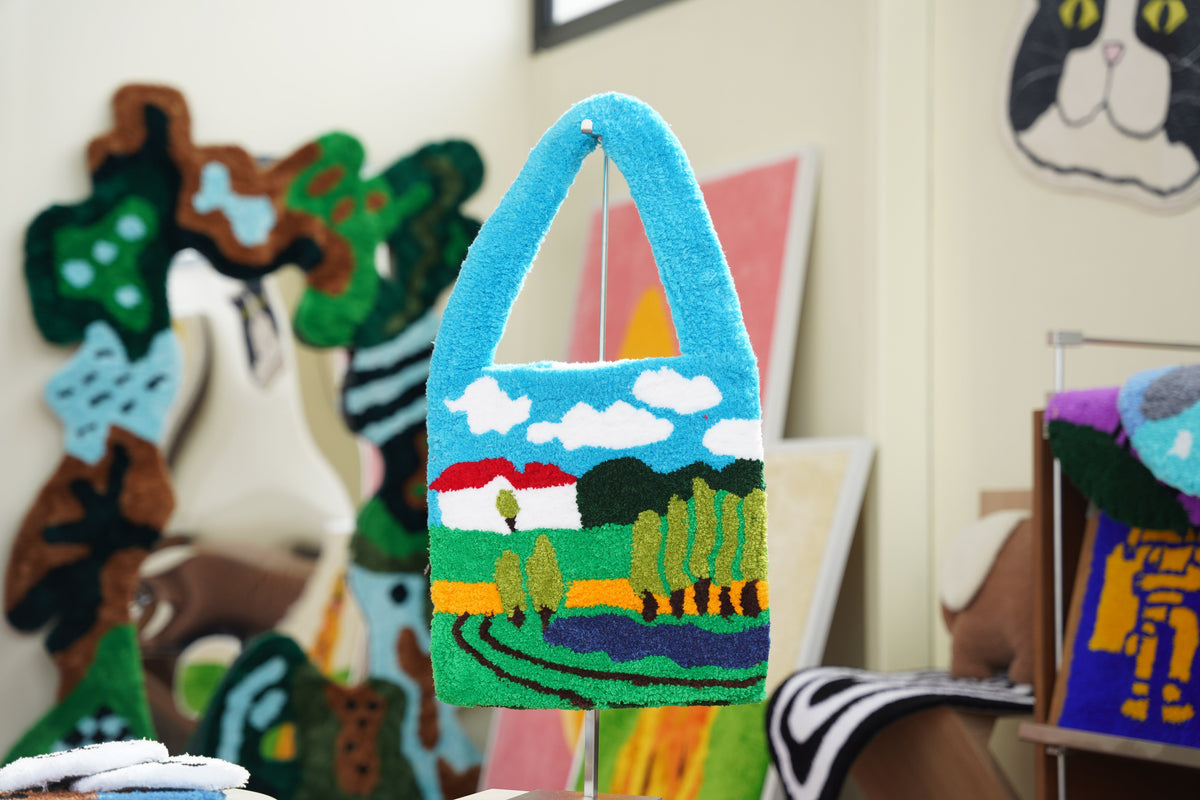
Nobody's first rug is the rug they were picturing. That one's usually the third or the fourth.
Which means the real question isn't what the equipment costs. It's what it costs to get to the rug you actually wanted.
Most cost lists stop at the first rug
Search this question and you'll find plenty of answers, most built the same way: a list of things to buy, a price beside each one, a total at the bottom. None of those totals agree — not because anyone got the prices wrong, but because they're all answering the same narrow question at different price points. What it costs to buy the equipment once.
Starting to tuft costs three things, paid in three different ways. Once. Again on every rug. And in hours. Only the first fits on a shopping list, and it's the smallest of the three.
What you pay once
Everyone prices this part, and it's the easiest to get right.
The tufting gun route is seven or eight separate purchases, each with a decision attached: a gun, a frame, primary tufting cloth, starter yarn, glue, backing fabric, and something to cut with. Add a beginner class and it lands somewhere between $395 and $895 depending on where you buy. We've broken that down piece by piece in our tufting gun vs automated machine comparison.
The machine route is one purchase, plus two things you probably already own: a flat table that can hold 17–23 kg steadily, and a Windows or macOS computer. No frame to build, no software subscription — Craftphilia Studio is free, updates included.
Open the box and the first rug is already covered: tufting cloth, a starter pattern and matching yarn, enough to finish one. That answers the two questions beginners actually get stuck on, and neither is about money — how much yarn to buy, and whether what arrives will work.
What you pay again on every rug
Yarn runs out. So do cloth, glue and backing, and none of them care which route you took. Over a year they'll outrun whatever you paid at the start.
Three things worth knowing before you stock up:
- Buy one cone before you buy ten. Make something small with it, see how it lays down and how it trims, then commit.
- Watch the cloth. It comes off a roll at a fixed width, so a 30 × 30 cm design still needs a full width stretched on the frame — the rest becomes off-cuts. Batch your small projects rather than running them one at a time.
- Nothing here is proprietary. The machines are built around 5 mm yarn and anything that fits works — acrylic, wool, cotton. If you already have a stash, it isn't wasted.
There's more on all of this in our guide to choosing yarn for tufting. For colours that stay consistent between orders, we've also been building a numbered colour system for tufting yarn.
The bill you pay in hours
Nobody invoices you for hours. They still get spent, and at the start they get spent heavily.
Count on 15 to 20 hours for a first rug done by hand — and expect the early ones not to come out the way you pictured. That happens to people with good taste and steady hands. It also has a cost: the cloth you tufted over, the yarn you pulled back out, and the evenings that went into both.
Then add the half of the job that runs past the point most people call finished. Tufting a rug isn't the same as finishing one. The glue, the day of waiting, the trimming and the carving are roughly half the work, and they happen after the last stitch whichever route you took. Ordinary trimmers and carving scissors handle that half — sold everywhere, and a shaver you already own works exactly as well as one with our name on it. Worth reading what rug finishing actually involves before you start rather than after.
Automation doesn't make starting cheaper. It makes the third rug arrive sooner.
Put the two routes side by side and the difference isn't where most people expect it.
Materials don't move. A machine won't make yarn cheaper, won't reduce how much cloth a design needs, and won't save you a drop of glue. Every rug costs what its materials cost, whoever laid the yarn down.
Hours are what move — and they move a long way. A piece that takes 15 to 20 hours by hand runs 1 to 5 hours on a CF05 or CF07. That gap isn't experience closing it, either. Transferring a design onto cloth, holding a consistent pace across a large area, keeping pile even from one side of a shape to the other: those are the parts that take rugs to learn by hand, and a machine does them the same way on rug one as on rug fifty.
Which changes what a year of tufting adds up to — not because you'll spend less time on it, but because a different share of that time goes into work only you can do. Two things don't get shorter either way: the design at the front and the finishing at the back. They just stop competing with the tufting for the same evenings.
What that buys isn't a cheaper start. It's a shorter distance between the rug in your head and the rug on your floor.
Spend the smallest amount that answers the question
Design the rug before you buy anything to make it with.
Craftphilia Studio is free whether or not there's a machine on your table. Bring in an image, separate the colours, and watch the tufting path appear across it — the rug you were picturing, laid out in front of you, before any money moves.
You find out whether you still want that rug once you can see it. And you find out how big it is, which is the number driving every cost in this article, from cloth width to hours per rug.
Then start small. A 40 × 40 cm rug teaches you what a large one does at a fraction of the hours — and the piece you designed first will come out better as rug three anyway.
So what does starting actually cost?
Three bills, and it's worth knowing the size of each.
Equipment is a few hundred dollars. You can price it precisely, everyone argues about it, and it's the only one of the three that ever gets totalled.
Materials repeat. Smaller every time, never zero, and over a year the largest of the three.
Hours repeat too. Fifteen to twenty on the first rug by hand, fewer on every rug after, and invisible on every list you'll read. This is the bill that decides whether you reach the rug you actually wanted or stop two rugs short of it — and it's the only one of the three that equipment can change.
Frequently asked questions
Why is tufting so expensive?
Because the sticker price is only the first of three costs, and the other two arrive after you've committed. Equipment is a one-time spend; materials repeat on every rug; hours repeat too, heavily at the start. People who call tufting expensive are usually reacting to the second and third, having budgeted only for the first.
Is rug tufting hard to learn?
The motion itself takes an afternoon. What takes longer depends on which part you're doing yourself.
By hand, the long part is consistency — even pile, clean lines, edges that hold. A first rug runs 15 to 20 hours, and the first two or three will teach you something rather than hang on a wall.
With a machine, the hand control comes off the table, so what you're learning from rug one is design: colour that holds together, scale that works on a floor, where the eye lands first. That's the harder skill, the one that still matters on rug fifty, and the one that decides whether a rug is worth making at all.
Is rug tufting a profitable business?
It can be, and what decides it is whether your prices cover the third bill. Materials are easy to add up. Hours are where beginners undercharge, because those hours felt like practice at the time. Price the finishing too — it's about half the work.
How much do people charge for tufted rugs?
Widely different amounts, which is why a range wouldn't help you. Work it out from your own side: materials for that specific rug, plus the hours it took, at a rate you'd accept for skilled work. If the result sits above what your market pays, the answer is usually a smaller rug or a faster process — not a lower rate.
Where do I buy yarn and cloth once the box runs out?
Anywhere that sells yarn to the right spec — Studio assumes 5 mm yarn, and acrylic, wool and cotton all work.
Do I get the Dual Spool Tray with the machine?
Machines ship with the single spool tray. The Dual Spool Tray is a separate purchase.
Share:
How to Choose the Right Tufting Machine Size
How Difficult is Tufting