
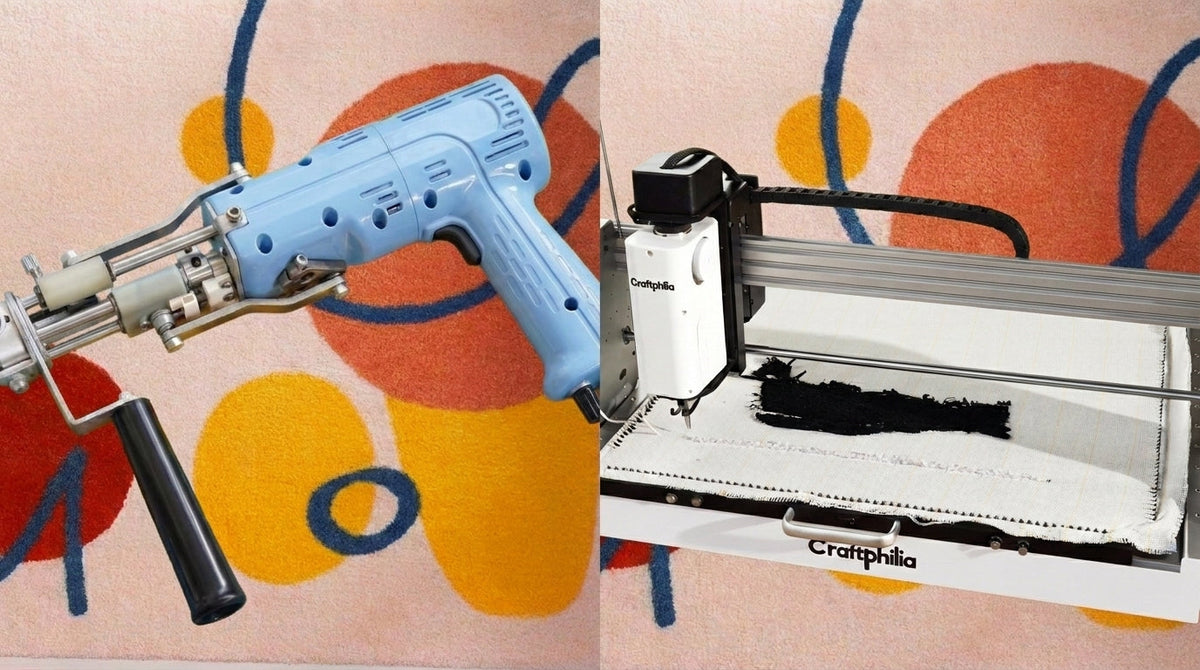
Tufting has always asked something of you before it gives anything back.
Stretch the cloth. Learn to hold the gun square. Keep the pace even for an hour, then another hour. Cut, glue, wait a day, cut again. Most people who try tufting don't quit because they lack the eye for it — they quit somewhere in that list, before the part they actually wanted to do.
That's the gap automation closes, and it's worth being precise about what it closes and what it doesn't. A machine doesn't make you more creative. It removes the months of practice standing between having an idea and being able to execute it cleanly — the same way autofocus didn't make photographers more talented, it let more of them get the shot they were already seeing.
What's left after that gap closes is the part that was always yours: the image, the colours, the shape, the finish. This guide covers both roads — what tufting by hand actually involves, and where a machine changes the equation — so you can see the whole map before picking a direction.
What tufting actually is
Yarn, pushed through a backing cloth stretched drum-tight on a frame, forming a pile on one side. That's the whole mechanism, whether a hand-held gun is doing the pushing or a machine is.
Two things make it different from other fibre crafts. It's fast compared to hand-hooking or latch hook — a small piece in hours rather than weeks. And it produces a genuine three-dimensional surface: pile that can be levelled flat or carved into relief, which is where a lot of the craft's character comes from.
The traditional route: what you're actually learning
A tufting gun automates the one motion — pushing yarn through cloth — and leaves everything else to you: the angle, the pace, the pressure, the direction of every row.
None of that is difficult to understand. All of it takes hours to get consistent. The learning curve isn't about talent, it's about repetition — your hand finding a steady rhythm it doesn't yet have. Expect a first rug to run 15–20 hours, and expect it not to look like the one in your head. That's normal, not a sign you're bad at this.
Then there's the half of the job most beginners don't know is coming. Tufting is roughly half the work. Gluing, a day of curing, trimming and carving make up the other half — and skip or rush it, and a rug sheds within months. (We cover that stage in full in what rug finishing actually involves.)
None of this is a reason to avoid a gun. Plenty of people want exactly this — the tension, the slow build, a piece that came out of their own hands from the first row to the last. If that's you, here's what to know about yarn and here's how a clean edge actually gets cut.
Where automation changes the equation
An automated tufting machine takes over exactly one part of that list: the execution. Upload an image, Craftphilia Studio separates it into yarn colours and generates the tufting path, and the machine runs it — the same line, the same pace, the same pressure, on stitch one and on stitch five hundred.
What that removes is the practice period, not the craft. You still choose the image. You still decide which four colours make it read as a face instead of a photograph. You still finish it by hand — the trimming and carving that give a piece its depth are exactly as hands-on as they've always been. The gap that closes is the hundred hours of repetition between having an idea and being able to produce it cleanly.
Which is also why it isn't a shortcut to worse work. A design built from clean colour blocks and finished with a carved edge reads as more considered than a rushed attempt at photorealism — not less.
Tufting isn't only rugs
This is where most beginner guides stop short, because most tufting content is written by and for rug makers. But the same mechanism — yarn through stretched cloth — produces far more than floor coverings, and it's worth knowing the range before you assume tufting means "rug."
- Wall art. Hangs instead of lying flat, so the finishing changes (lighter backing, no anti-slip layer) but the tufting doesn't.
- Shaped and irregular pieces. A cloud, a logo, a portrait cut to its own outline rather than a rectangle.
- Carved relief. Depth cut into a flat surface — the shape still lies flat, but the surface has height variation where colours meet.
- Three-dimensional objects. Cushions, soft toys, bag panels, footballs — built from flat tufted panels sewn together, not tufted as a solid shape.
- Small functional pieces. Coasters, patches, keyrings — the cheapest way to practise a technique before committing to something larger.
Whether any of that is worth making by hand or with a machine comes down to the same trade-off as a rug: how many you want to make, and how much of the execution you want to be doing yourself. (We go through each format properly in tufting beyond rugs.)
What decides whether a piece looks good
Neither a gun nor a machine decides this. Three things do, and they're the same three whichever tool is tufting.
The image. Photographs hold detail that yarn can't render below a certain size. A design has to be simplified into flat colour blocks before it can be tufted well — fewer colours, bigger shapes, edges that still hold at the size you're actually making.
The finishing. Glue, cure, trim, carve. This is where a piece gets its clean edges and its depth, and it happens after the tufting regardless of what did the tufting.
Practice with the tools that stay yours. Carving especially — the 45-degree cut that turns a flat colour boundary into a shadowed edge is a hand skill, and it's the same skill whether the yarn underneath it was placed by a gun or a machine.
How to actually start
- Design before you buy anything. Craftphilia Studio is free and works with no machine required — bring in an image and see it separated into colours and a tufting path before any money moves.
- Start small. A 30–40 cm piece teaches you what a large one does, in a fraction of the hours, whichever tool you're using.
- Budget for the whole job, not just the tool. Cloth, yarn, glue, backing and a trimmer add up whether you're using a gun or a machine — the tufting is only ever part of the cost. The full breakdown is here.
- Decide what you actually want. If the making itself is the point, a gun is the right tool and no machine improves on that. If you have ideas you want made and the practice hours are the obstacle, that's what automation is for. The full comparison is here.
Frequently asked questions
Is tufting hard to learn?
The motion itself takes an afternoon to understand. Getting it consistent — even pile, a steady pace, clean lines — takes longer, and a first hand-tufted piece usually runs 15–20 hours. What takes longer to learn than the tufting is the finishing: gluing, curing and carving, which is roughly half the job either way.
Do I need to be artistic to tuft?
You need to make design decisions — colours, scale, simplification — more than you need drawing skill. Plenty of tufted work starts from a photograph rather than an original drawing, and turning that photo into something tuftable is a learnable skill, not a talent.
What's the difference between a tufting gun and an automated machine?
A gun automates one motion — pushing yarn through cloth — and leaves the angle, pace and path to your hand. A machine executes a path generated from your image, so the mechanical repetition comes off your hands while the design and finishing stay with you. Full comparison here.
Can I make anything other than a rug?
Yes — wall art, shaped pieces, carved relief, and three-dimensional objects like cushions and soft toys all use the same tufting mechanism, with the design and finishing changing rather than the tufting itself.
How much does it cost to start?
By hand, a full gun setup with materials and an optional class typically runs $395–$895. A Craftphilia CF05 starts at $699 and ships with the cloth, pattern and yarn to make a first rug. The full breakdown, including ongoing materials, is here.
What should my first project be?
Something small — a coaster or a 30–40 cm piece. It teaches the technique, whichever tool you're using, without the hours or materials cost of a full-size rug.
Share:
How Much Does It Cost to Start Making Tufted Rugs
Tufting vs Punch Needle vs Latch Hook vs Rug Hooking: Which Craft Should You Try