
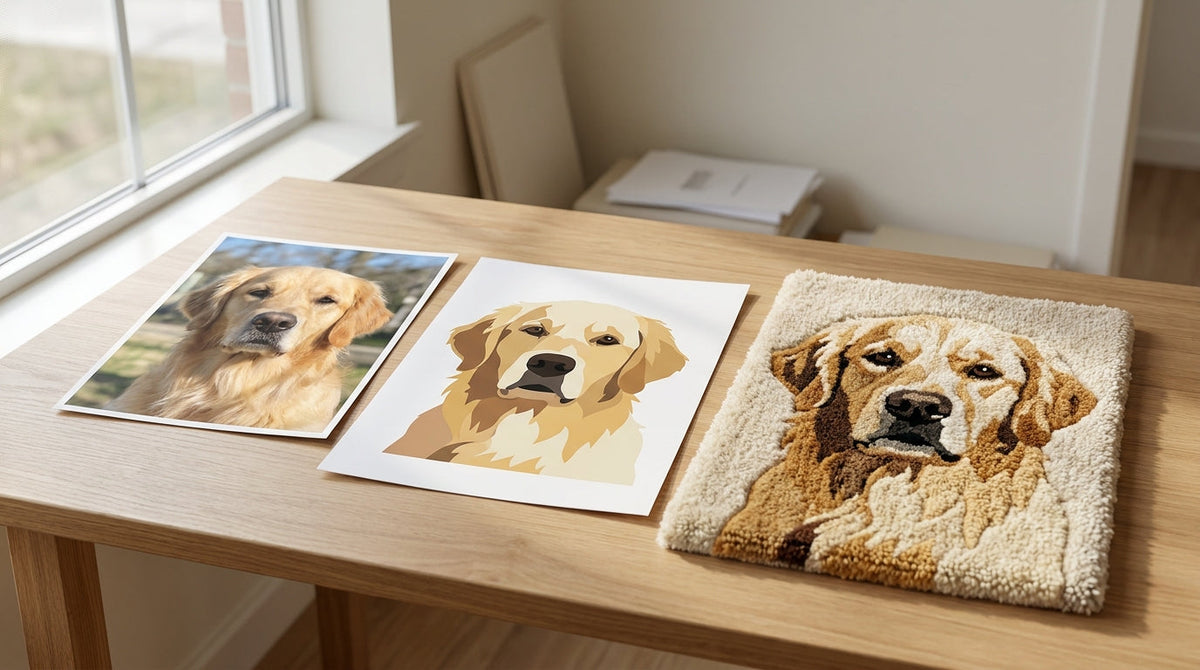
Pet portraits are among the most popular custom orders in tufting. Browse enough maker shops and the same subjects come back around — dogs, cats, logos, anime characters, abstract shapes. But a pet portrait is the one rug a customer can't buy anywhere else, because nobody else has their dog.
It's also the order with the most ways to go wrong, and the one makers underprice most reliably.
You're not selling square footage. You're selling photo review, design decisions, revisions, tufting, finishing — and the risk of making a piece that fits one customer and nobody else.
It starts with the photo, and usually ends there too
Everything downstream depends on the image the customer sends. Yarn can't show a detail that wasn't in the photo to begin with. If the dog's eyes are lost in shadow, they'll be lost in wool too, and no amount of careful carving brings them back.
Which is why experienced makers turn down an unusable reference and ask for another. Reshooting the pet is cheaper than finding the problem halfway through production.
What to ask for:
- Taken at the pet's eye level, not from above
- Face turned toward the lens
- Both eyes, both ears and the full outline of the head inside the frame
- In focus, in daylight rather than flash — flash flattens fur and puts a hard shine on the nose
- Several shots, not one. The first photo a customer sends is rarely the best one they have
Dark coats
Black dogs and black cats are where custom pet orders go sideways — and the tufting isn't what fails.
Dark fur absorbs light instead of bouncing it back. On a phone camera that averages the whole scene, a black cat comes out as a silhouette with two eyes floating in it: no cheekbone, no muzzle, no texture. Put that cat against a dark sofa and the outline disappears as well.
The fix happens at the camera, not at the frame. A mid-tone or light background separates the animal's edge from what's behind it. Window light or open shade gives the coat something to catch. And the photo shouldn't be brightened until the fur turns grey — a black coat that reads as grey comes back as grey yarn, and the customer will know something is off without being able to say what.
If a customer only has dark, murky photos, say so before taking the order. Reshooting the pet costs them ten minutes. Rebuilding the rug costs you a week.
Turning a photo into colour blocks
Photographs hold continuous gradients. A tufted rug works from a finite set of yarn colours, so those transitions have to become regions with boundaries before anything gets tufted.
The technical name is posterization — collapsing continuous shading into flat regions with hard edges. Portrait tufters have been doing it for years in Illustrator and similar tools.
Four to six colours is a workable starting point for a face. Enough for the shapes that carry a likeness, few enough to keep the yarn changes manageable. Go higher when the piece is large or the coat is patterned.
Fewer colours sounds like a compromise. It isn't. A portrait built from flat shapes, bold outlines and four colours reads better across a room than an attempt at photorealism — and reading from across the room is what a rug is for. It's also the version customers recognise from the doorway.
Once the image is flat colour blocks, Craftphilia Studio separates them into layers by colour, cleans up stray pixels and ragged edges, and generates the tufting path for each layer. It's free, and it works with a tufting gun as well as with our machines.
The gap between colours
Two shapes that sit against each other in the design will run into each other on the rug. Yarn has thickness, the backing has weave, and a boundary drawn as a line ends up as a smudge.
Tufters usually handle this by leaving space between neighbouring colours and cleaning up the boundary with shears afterwards. Studio moves that step earlier: a setting called erosion pulls each colour block back from its boundary, so the margin is in the file before anything gets tufted rather than in your wrist while it does.
There's no single correct value — it depends on yarn thickness, how the shapes sit against each other, and how deep you plan to carve.
What matters for portraits is the consequence: below a certain size, a colour patch has nothing left once its neighbours pull back. A whisker won't survive as its own colour. An eye highlight will, if you give it room at the design stage rather than discovering the problem at the carving stage. For what happens at those boundaries afterwards, see carving clean edges.
Choosing a size
| Size | What it holds | Working area |
|---|---|---|
| Up to 50 cm | A simple head portrait. The size most wall hangings land on. Facial detail gets harder to hold as the design gets busier. | CF05, 500 × 500 mm |
| 50–70 cm | Room for eyes, markings and the shapes that carry a likeness, without becoming a large-format commission. A 60 cm square sits here. | CF07, 700 × 700 mm |
| Above 70 cm | Materials, tufting hours and shipping all start to matter more — quote it as a different class of job. | Expansion Kit, or made in sections and joined after finishing |
Pricing a custom portrait
Rug pricing starts from area, and the method that matters — costing your own materials, hours and overhead rather than copying someone else's number — is in how to price your handmade rugs.
But area rates alone won't get you to what pet portraits actually sell for. Small pieces often sit in the $150–300 region; 60–80 cm pieces can run $300–600. Raising your rate per square foot doesn't close that distance either, because the missing work isn't on the rug's surface.
Two things live outside the area calculation:
Pre-production time. Reviewing photos and rejecting the unusable ones. Turning a photograph into a flat colour design. Sending it over. Adjusting it because the ears aren't right, or because the colour of the coat isn't the colour of the coat. None of it appears in square footage, and all of it is billable.
Risk. A rug designed around one customer's pet has almost no resale value if the order falls through. A geometric rug goes into your shop; a portrait of a stranger's dog goes nowhere. That risk belongs in the price, not in your stomach.
So a portrait quote has three parts:
- An area rate for the rug itself — yarn, backing, glue and the tufting.
- A design fee for the round trip: photo review, the flat colour design, and a named number of revisions.
- A deposit up front. It covers materials if the order collapses, and it filters out enquiries that were never going to become orders. A fixed figure on smaller work, a percentage on larger.
Automation changes part of this arithmetic and not the rest. Running the tufting pass frees the hours you'd spend at the frame, so more orders move through the same studio — and once repeat orders start arriving, running them as a batch is a different job again. The design, the conversation and the finishing stay yours — which is also where most of the value was.
Show the design before you tuft it
The customer has a photo in their head. You have colour blocks on a screen. Those are not the same picture, and the difference has to surface before the yarn goes in.
Someone expecting every stripe on their tabby needs to see the simplified version — four or five colours instead of every stripe — while it can still be changed.
That conversation costs an email now. It costs a rug later.
Send the design, wait for a yes, then start.
Frequently asked questions
How do I price a portrait with two pets in it?
Not by doubling the area. Two heads on one piece of cloth means each face has less room for the details that make it recognisable, so those details start hitting the minimum block size. Scale the rug up to give both faces space. The design side costs more than twice a single portrait: two sets of decisions, plus a composition problem a single portrait doesn't have.
How many revisions should a design fee cover?
Name a number when you quote. One round is a fair default for a straightforward face. Past that, charge per round — a customer revising a fourth time is usually trying to describe something they can't name, and a per-round fee ends that faster than patience does.
What if the customer says the finished rug doesn't look like their pet?
If the finished rug matches the approved design, you have a clear reference for what they agreed to. Without that step, you have nothing to point at. Keep the approved image with the order, and set your remake and revision policy before production starts.
Should I take photos of the pet myself?
Only if the customer is local and the order is large enough to justify the time. For most orders it's cheaper to send clear photo instructions and reject what doesn't meet them. A rejected photo costs one email; an unusable one costs a rug.
Can I use a photo the customer didn't take?
Be careful with professional pet photography — those images are usually the photographer's copyright, not the owner's, even though the pet is theirs. For a one-off private commission it rarely becomes an issue, but don't put the result in your portfolio or shop listings without asking.
Share:
Making Multiples: How to Tuft a Small Production Run for 2026
How to Start an Etsy Tufting Shop (and Keep the Orders Coming) in 2026