
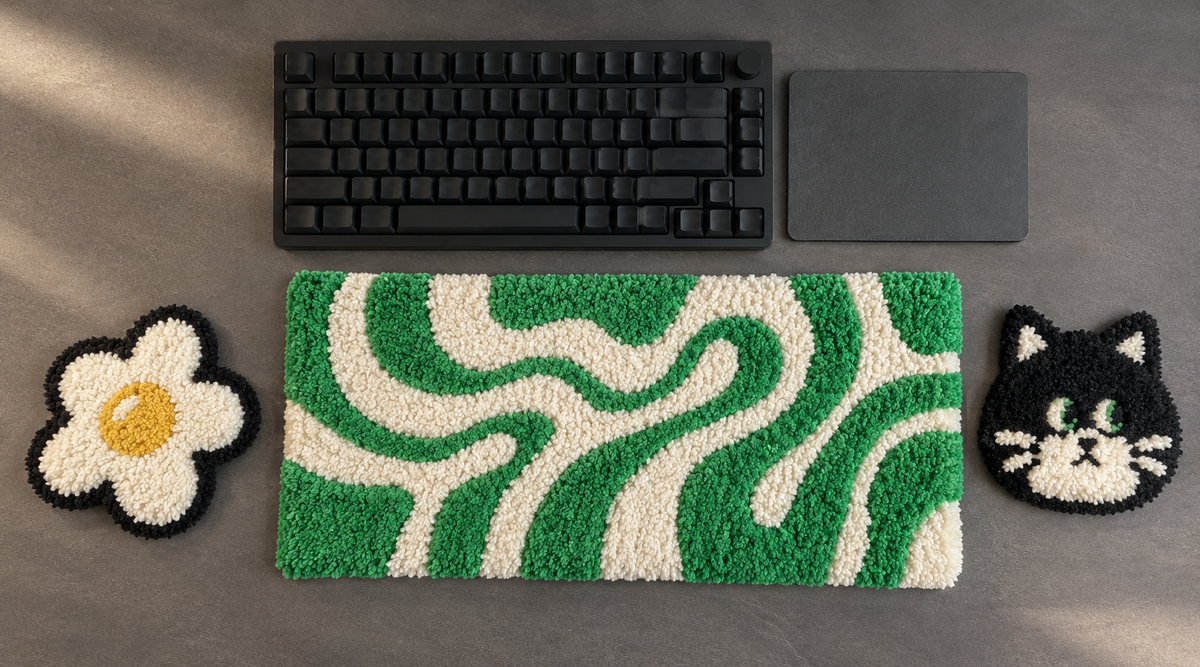
Etsy is often the first place tufters go when a hobby starts paying for its own yarn. It's a marketplace built for handmade goods, and its buyers are already looking for one-off and personalised pieces — which is what most tufted work is.
Opening a shop is the quick part. The harder part is the second order, and the tenth. A shop keeps selling when each finished order brings in the next one — a good piece earns a good review, the review lifts the listing in search, and search brings the next buyer. Every section below feeds that loop, from what you make to how it reaches the door.
1. Choose a niche buyers already want
The easiest pieces to sell are the ones buyers arrive already wanting.
- Pet portraits. Tufted from the customer's own photo. The buyer comes with the request already formed, and there's nothing identical to compare your price against. (How pet portrait rugs are made and priced.)
- Names and nursery pieces. Easy to personalise, and usually bought as gifts.
- Logo pieces. Studios, cafés and streamers buy them as branded décor — and they tend to come back.
- Anime and pop-culture style. Popular for gaming rooms and streaming setups. Original designs in that style are fine; existing characters are not yours to sell (more in the FAQ).
- Small formats. Mug rugs, coasters and wall pieces are cheap to ship and easy to buy on impulse.
Pick one or two and keep the shop to them. A buyer should be able to tell what you're good at from your first row of listings. For which categories move, and at what sizes, see what actually sells.
2. Make sure you can make it the same way every time
Once you know what you'll sell, the next question is whether you can produce it reliably. Most of the work in these niches is personalising a design and then making it again — and a shop that keeps selling asks a few things of whatever makes its pieces.
- Consistent quality. Repeat buyers and matched sets need each piece to come out like the last. A Craftphilia machine runs the same file the same way every time, so the tenth order matches the first.
- Fast turnaround on custom work. Personalised orders are where buyers wait longest. The customer's photo goes into Craftphilia Studio, and the machine tufts the design in one to five hours.
- Your hands free for the rest. Finishing, packing and answering buyers all need you. The machine pauses at each colour change and waits for you to load the next yarn — it doesn't need you standing beside it in between.
- More from one design. A bestseller earns more when it comes in options. Offer one design in several colourways as listing variations, each tufted from the same file — and with numbered yarn colours in Studio, a reorder in "colourway 3" comes back in exactly the same yarns.
- Range. The CF05 tufts up to 50 × 50 cm (50 × 100 cm with the Expansion Kit); the CF07 up to 70 × 70 cm (70 × 140 cm with its kit). Larger pieces can be tufted in sections and joined (choosing a machine size). Loop pile, which the machines don't tuft, and freehand pieces worked without a file are where a tufting gun still earns its place (gun vs machine).
Whichever tool lays the yarn, the design, the colours and the finish are in your hands — and that's the part your buyers are paying for.
3. Open the shop in five steps
With something to sell and a way to make it, opening the shop itself is straightforward:
- Choose your shop language, country and currency.
- Pick a shop name. Make it something buyers can remember and spell.
- Connect a bank account for payouts and a card for fees. Some regions pay a one-time set-up fee at this step.
- Verify your identity with a government ID and a selfie.
- Publish your first listing, and the shop opens.
4. Get found: Etsy SEO and listings that convert
An open shop still has to be found, and on Etsy that starts with the words in your titles and tags.
- Use the buyer's words, not the maker's. Makers say "tufted art"; buyers search "dog portrait rug", "nursery name rug", "gamer room mat". Lead the title with what the piece is and who it's for.
- Use all 13 tags, including the occasions people buy for: housewarming, nursery, birthday, wedding.
- Fill in every attribute — colour, size, material. Etsy's search reads them too.
- For US shoppers, free shipping helps you in search. For rugs, that means building shipping into the price.
Once a buyer finds the listing, the photos have to do what their hands can't:
- Cover photo: the whole piece, clean background, even light.
- Close-up: the pile and any carved edges, lit from the side so the texture reads.
- Scale: the piece beside a chair, a foot or a pair of hands.
- Video: a few seconds of a hand running across the surface.
Etsy requires listings for items you make to use original photos or video of the finished product. For custom listings, that means the first photo should be a real finished custom piece — not a blank or a mockup — so make your samples before you open custom orders.
The description answers what the photos can't: finished size in centimetres and inches, the fibre, the backing, whether the piece is for the floor or the wall, and how to care for it.
5. Set a price that leaves you money
A click only matters if the sale leaves you money, and a tufted piece's price has to cover more than yarn.
- Materials scale with area. A rug twice as wide and twice as long takes roughly four times the yarn, cloth and glue.
- Your hours. Count design prep, stretching the cloth, colour changes, finishing and packing.
- Shipping. Rugs ship big, and carriers charge by size as well as weight. Price it from a real packed piece, not a guess.
Etsy takes its share of the whole order, shipping included, and that weighs more on rugs than on most crafts. For a US seller, as of 2026:
| Fee | Rate | When |
|---|---|---|
| Listing | $0.20 | Each listing, renewed when it sells or after four months |
| Transaction | 6.5% | Of the item price plus shipping |
| Payment processing | 3% + $0.25 | Every sale through Etsy Payments |
| Offsite Ads | 15% (or 12%) | Only on sales from Etsy's ads elsewhere, capped at $100 per order. Optional under $10,000 a year in sales; mandatory at 12% above it |
Without Offsite Ads, that's roughly a tenth of what the buyer pays. Whether you charge shipping separately or fold it into the price for the free-shipping boost, the fees come out the same. For the full arithmetic — including what a machine changes about your hours — see how to price your handmade rugs.
6. Deliver on the date you promised
A sale isn't finished until the piece arrives, on the date you promised. The processing time on your listing is that promise, so set it from the whole job, finishing included.
The tufting is rarely what holds an order up — the finishing is. Gluing, curing, backing and trimming are hand work today and make up roughly half the job (what rug finishing involves), and that's where orders queue (making multiples).
It's also where a Craftphilia machine saves you the most time. Once a piece has cured and come off the frame, the machine tufts the next order while you trim, back and pack the last one. The two jobs overlap instead of taking turns.
Pack the piece rolled, never folded, so it arrives looking the way it left:
- Roll it pile-in, so the face is protected and the backing takes the knocks.
- Wrap it against moisture before it goes in the box.
- Use a box or mailer sized to the roll, so it can't shift in transit.
- Add a care card and a short thank-you note.
Every order that arrives on time and in good shape earns a review, and reviews carry your listings back up in search — in front of the next buyer. That's the loop an Etsy shop runs on, and it starts again with the next piece you make. For the machine side of it, our complete guide to automated tufting machines walks through it.
Frequently asked questions
Can I sell pieces made with an automated tufting machine on Etsy?
Yes. Etsy's Creativity Standards count items made with computerised tools — they name laser cutters, 3D printers, CNC and Cricut machines — as made by the seller, provided you produce them in your own shop or home from your own original design. Personalised pieces made to a buyer's specification, like a portrait from their photo, fit squarely within that. The machine lays the yarn; the design, the colours and the finish are your work.
Can I sell designs from a pattern library or an AI image generator?
Be careful here. Etsy requires computerised-tool items to come from the seller's original design, and doesn't treat seller-prompted AI creations as made by the seller. Pieces tufted straight from someone else's template or an AI-generated image may not qualify. Use them for practice, and build your shop on your own designs and customer commissions.
How much does it cost to start an Etsy tufting shop?
On Etsy's side, very little: $0.20 per listing, plus a one-time set-up fee in some regions. Most of the start-up cost is equipment and materials, which we break down in how much it costs to start tufting.
What sells best for a new Etsy tufting shop?
Personalised work — pet portraits, names and logo pieces — because buyers arrive with the request already formed. For ready-made pieces, mid-size work between roughly 40 and 70 cm is the easiest to sell and ship (what actually sells).
Can I sell rugs with anime or cartoon characters?
Original anime- and cartoon-style designs are fine, including characters your customer designs. Existing characters, game art and brand logos belong to their owners. Etsy removes listings when a rights holder reports them, and repeated reports can cost a shop its selling privileges.
How long should the processing time be for a custom piece?
Long enough to cover the whole job: design approval, tufting, colour changes, finishing, and the glue curing, which can take up to a day. Set it from how long a piece actually takes you from approved design to packed box, not from the tufting alone.
Share:
Custom Pet Portrait Rugs for 2026: How They're Made and What to Charge
Should You Sell on Etsy, Instagram, or Your Own Site?(2026)