
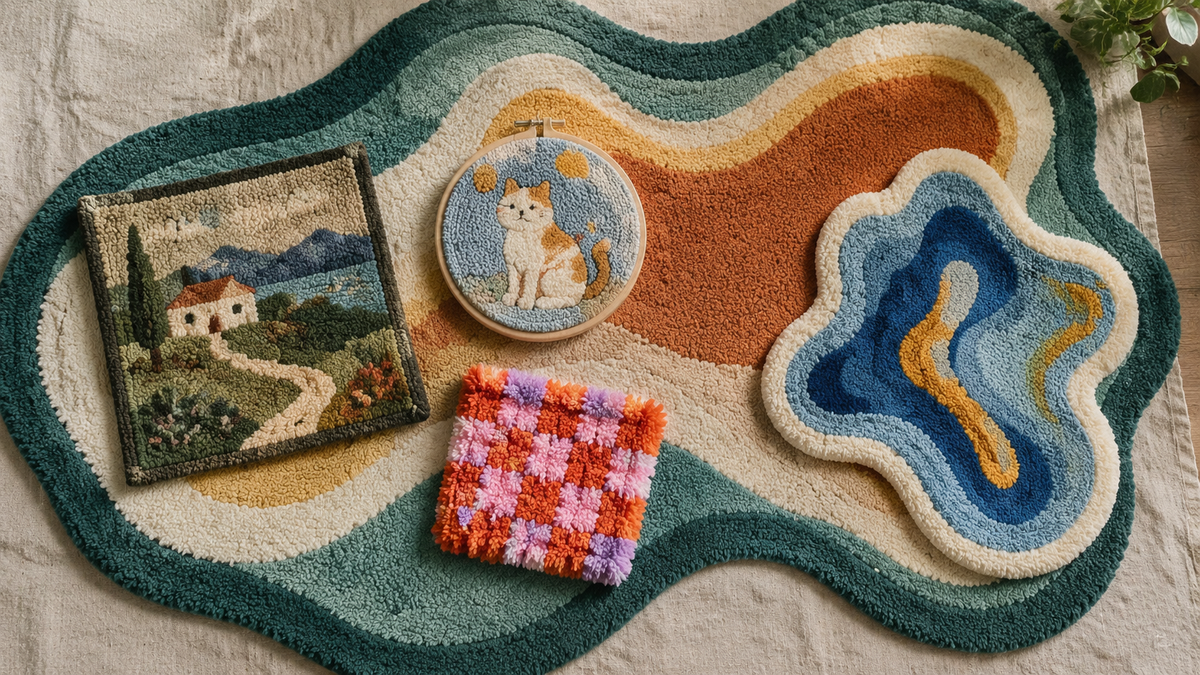
You've seen the finished pieces. A shaggy checkerboard rug, a punched wall hanging, a chunky wool mat that looks a hundred years old.
What a photo can't tell you is which of them took a weekend and which took six weeks — or which needs $25 of supplies and which needs a machine on your table.
These four crafts get compared in the same breath, usually on what each one makes. The more useful comparison is what each one asks of you in return: evenings of repetition, a steady hand, patience for counting, or money up front instead of hours. Those don't move together, and the trade you're comfortable making is what decides which craft you'll still be doing in a month.
What actually separates them
All four push, pull or tie yarn into cloth until a soft surface builds up. Here's where they diverge.
| How the pile forms | Cost to start | Speed | Finish work | |
|---|---|---|---|---|
| Rug hooking | Loops pulled up from the front | $55–90 starter kit | 6–8 hrs per sq ft | Bind the edges. No glue |
| Punch needle | Yarn pushed down from the back | ~$35 needle, plus cloth and yarn | 8×8 in over a weekend | Bind or hem. No glue |
| Latch hook | Short yarn tied onto a grid | $15–25 full kit | 15–30 hrs for 20×30 in | Knots hold themselves |
| Tufting | Yarn pushed from the back, by tool or machine | $150–600 gun kit · CF05 from $699 with materials | ~1 hr per sq ft | Glue, back, cure a day, then trim |
Three stages, every craft
Whichever one you pick, you pass through the same three stages. What changes is how much each one asks of you.
Design — getting an image onto cloth
Rug hooking and punch needle need outlines only. Trace the shapes onto the backing and decide colours as you work, loop by loop.
Latch hook needs the whole image resolved first. The canvas runs three to five holes per inch, so the design has to be reduced to one colour per square before anything is tied — most kits print the pattern onto the canvas for you.
Tufting flattens the image into colour areas — the same job latch hookers do by hand, except software does it. Upload an image to Craftphilia Studio and it separates the colours and generates the path the machine follows.
Making — where the four diverge hardest
Roughly six to eight hours per square foot by hand, against about an hour with a gun or machine. A piece that takes a hooker three weekends comes off a tufting frame in an afternoon.
Finishing — turning a worked surface into an object
Rug hooking, punch needle and latch hook need their edges bound, and that's it. Packed loops and tight backing hold the pile; latch hook knots hold themselves.
Tufting has to be glued, backed with a secondary cloth, and left to cure for a day before it's stable. That's the hidden half of the job beginners don't plan for — we cover it in what rug finishing actually involves.
The hand crafts: slow, cheap, detailed
These three trade time for detail and a low entry cost. All are cheap to start, all are slow, and the quality comes out of your hands rather than your equipment. What they can't give you is scale — a flat piece, small enough to finish in a reasonable number of evenings, is where this side of the craft lives.
Traditional rug hooking
The quiet one. You hold a hook like a pencil, work from the front, and draw loop after loop of wool strip up through burlap or linen. Old clothing works as material.
Narrow strips give you shading a photograph would recognise; wide strips give you something that looks like it came out of a farmhouse in 1880. It holds finer detail than anything else here, tufting included. What it asks for is time, plainly: a floor rug is measured in weeks rather than evenings — and people who love this craft love it for exactly that reason.
Punch needle
The same loop, made from the other side. You push a hollow needle down through drum-tight cloth and the loops form on a face you can't see while you work — the one thing beginners find strange for about an hour. After that it's faster than hooking and easier to control, and mistakes pull straight back out.
The needle is the cheapest real tool in this group: thin needles and thin yarn for detail, thick needles and rug yarn for floor pieces.
One quirk to plan for: because you work from the back, the finished piece comes out mirrored. Any design with text or a clear direction has to be reversed before you trace it.
Latch hook
Asks the least in skill and gives back the most predictably. You tie pre-cut yarn onto a printed mesh, one knot at a time, following the grid like a cross-stitch chart. You can do it on the couch with a show on, and you will finish what you start.
What it asks for is patience of a particular kind: thousands of identical knots, one at a time. What you give up is detail — each knot covers about a quarter inch, so bold shapes and flat colour survive the grid while fine lines and soft shading don't. Each knot leaves two cut ends standing up, which is the shaggy surface people recognise from the seventies.
What only tufting makes
Tufting is where the money goes in and the hours come out. Roughly an hour per square foot against six to eight by hand — which means a rug stops being a seasonal commitment and becomes something you can be wrong about and try again.
But speed is the smaller half of it. The three hand crafts make flat pieces, and within that they make them beautifully. Tufting makes things beyond that:
- Rugs at real size. A room-sized piece is realistic here and nowhere else on this list.
- Shaped pieces. Cut to a cloud, a logo, an animal's outline — any shape that isn't a rectangle.
- Carved relief. Depth cut into the surface after the glue sets, so colour boundaries fall into shadow.
- Three-dimensional objects. Cushions, soft toys, bag panels, sculptural work — built from flat tufted panels sewn together.
We go through each of those formats in tufting beyond rugs.
It has two real costs
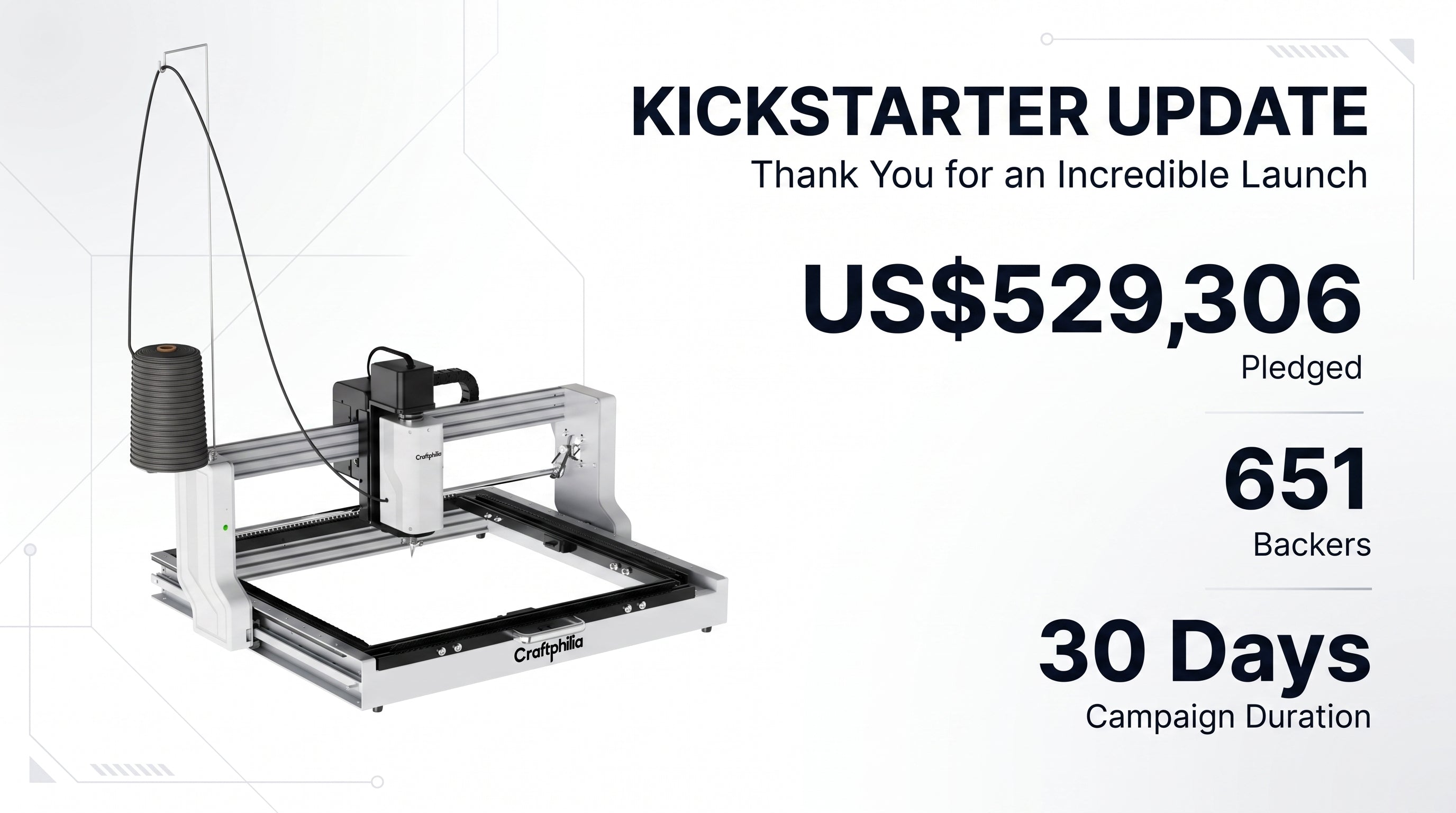
The tool. A full gun setup with materials and an optional class typically runs $395–$895. A Craftphilia CF05 starts at $699 and ships with the cloth, pattern and yarn to make a first rug. That's a one-off sum you pay before you make anything — the speed and range you get back are real, but so is the number on the invoice.
Detail. Guns and machines can't take yarn as fine as the other three crafts use, and yarn thickness sets the smallest shape the pile can hold. Fine lines, small text and gradual shading don't survive. Every hand craft on this list beats tufting here, and rug hooking with narrow strips beats it by a wide margin. If your ambition is a photographic portrait at A4 size, tufting is the wrong tool.
And tufting itself splits in two
That split matters more than the price difference.
With a handheld gun, you guide every line, and how steady your hand is decides the finished texture — most people need 15 to 20 hours on a first piece before the rows look even. Plenty of makers stay with the gun for exactly that: the pace, the control, the feel of the yarn.
With an automated machine, you supply the image and the machine runs the path. The repetitive execution moves from your hands to the machine, while the design decisions and the finishing stay yours.
We compared the two properly in tufting gun vs automated machine.
How to choose the one you'll actually like
Forget which is best. Ask what you want out of the next few evenings.
You want the cheapest way in, and something to do while watching a show. Latch hook. One kit, no setup, and you'll finish it. Blocky designs are the price.
You want to draw with yarn. Punch needle first — cheap and quick to learn. If you find yourself wanting finer shading, or you like the idea of cutting up old wool coats, traditional rug hooking is the deeper version of the same pleasure, at several times the hours.
You want rugs at real size, or shapes and objects rather than flat rectangles. Tufting. Speed and scale come easy; the cost sits in the setup, and in the finishing that follows every piece.
You're curious about tufting but not ready to spend. Buy a hand punch needle. The motion is the same one a tufting gun automates, so $35 tells you whether you enjoy pushing yarn through cloth from the back. It won't tell you anything about speed, density or scale — but it answers the first question cheaply.
Frequently asked questions
Does a machine make the piece less handmade?
It moves where your hands go, not whether they're involved. The machine executes a path; you still choose the image, decide how far to simplify it, pick every colour, and do the entire finishing stage by hand — the gluing, the trimming, the carving that gives a piece its depth. What it takes over is the repetition, the part that costs beginners 15 to 20 hours before their rows look even.
Are any of these suitable for kids?
Latch hook, easily — the tool has no point and mistakes untie. Punch needle and rug hooking both involve a sharp tool but are manageable with supervision. Tufting is a power tool with a fast reciprocating needle; most studios set their minimum age at 14, and that's a reasonable line at home too.
If I learn one, does it help with the others?
Some of it transfers. Punch needle and tufting share the same motion, so the hand knows what to do either way. Rug hooking and punch needle share materials and the same instinct for packing loops. Latch hook transfers the least — it's a different action entirely. What transfers across all four is the part that has nothing to do with the tool: simplifying an image, choosing colours that read in pile, and finishing an edge cleanly.
Can I make a rug I'd actually walk on?
With any of them, yes. Consider the hours first: a 20×30 inch latch hook rug is 15–30 hours, the same area by hand hooking is longer, and by tufting it's an afternoon plus a curing day.
Which one is cheapest to try?
Latch hook, at $15–25 for a complete kit with everything included. Punch needle is next at around $35 for the needle, though you'll add cloth and yarn on top. Both cost less than a single tufting class.
Share:
How Difficult is Tufting