
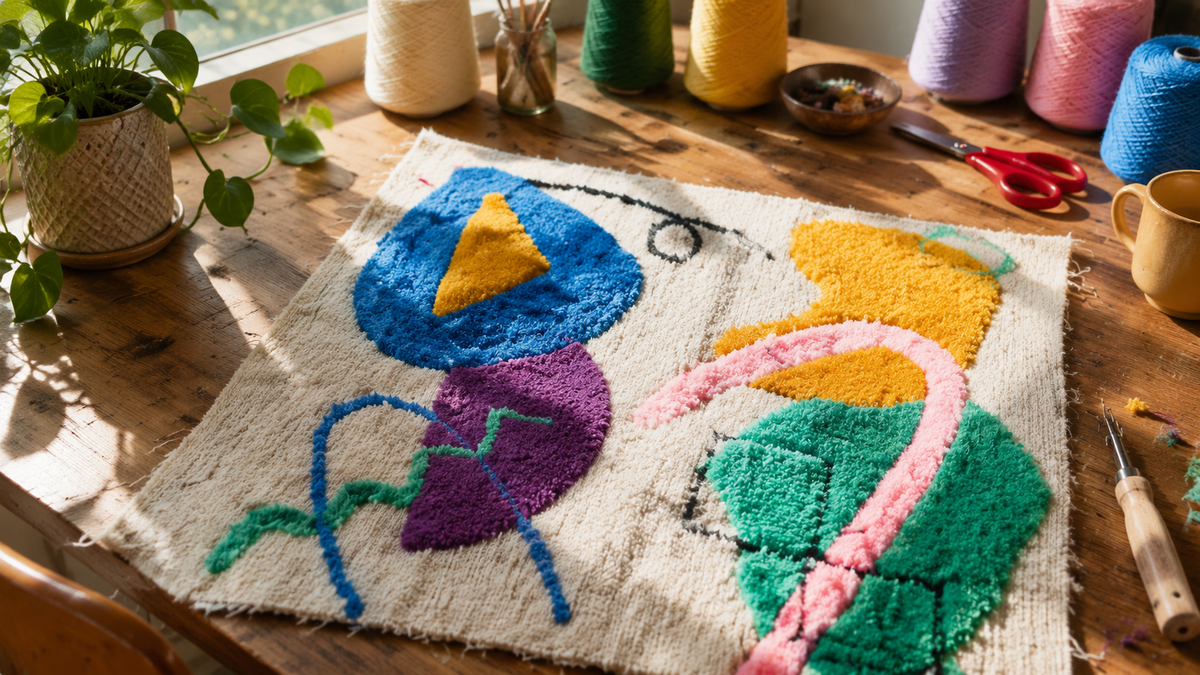
Every tufted piece starts with the same move: a loop of yarn pushed through cloth and left standing on the other side.
That move is older than any tool built to make it. For a long time it was made with a needle and a thimble. Then a converted sewing machine took it over, then factory machines with rows of needles, then a tool you could hold in one hand. Each change decided two things: how fast a piece could be made, and who got to make one.
Here's how tufting got from a teenager's bedspread in Georgia to a machine that runs on your table.
Candlewick to chenille: tufting by needle
Before tufting was an industry, it was a bedspread. American households had candlewick spreads — heavy cotton thread stitched into plain cloth in raised patterns, often handed down rather than bought.
In the early 1890s, a 12-year-old named Catherine Evans saw one at her cousin's house near Dalton, Georgia, and decided to make her own. Nobody around her could explain how it was done, so she worked it out. She sewed thick cotton yarn into unbleached muslin with a running stitch, clipped the loops so the ends fluffed out, then washed the whole spread in hot water. The cloth shrank and gripped the tufts tight. By 1900 she had sold one for $2.50.
Orders followed. She taught other women the stitch and gave away her patterns, and merchants in the Dalton area built a whole system around it. "Spread houses" stamped designs onto sheeting, and haulers carried the stamped sheets and yarn out to farmhouses across north Georgia, Tennessee and the Carolinas, then came back to collect the finished spreads and pay by the piece. By the 1930s, close to 10,000 people were tufting at home for 10 to 25 cents a spread — for many families, the cash that carried them through the Depression.
Spreads hung on clotheslines along US Highway 41 for passing tourists. The bestselling design was the peacock, and that stretch of road became known as Peacock Alley.
The sewing machine that learned to tuft
Hand tufting had a hard ceiling: one needle per person. By the 1920s, tufted spreads were on department store shelves in Atlanta, New York and Philadelphia, and porch work couldn't keep up.
Through the 1920s and '30s, mechanics around Dalton went after the stitch. One of the best-known answers came from Glenn Looper's foundry in Dalton. It took a single-needle industrial Singer sewing machine, set it up to drive thick yarn into muslin without tearing it, and fitted a knife to cut each loop as it formed. Machines with four needles followed, then eight, then twenty-four, sewing parallel rows of tufts in one pass.
Between 1936 and 1950 the patents piled up. One by Joe Cobble and George Muse sewed a whole row of tufts at once, and Dalton's own historical markers treat it as the ancestor of today's carpet-tufting machines.
Factories didn't take over on speed alone. In the 1930s, federal wage-and-hour rules for the bedspread trade made piecework at home harder to run, and production moved indoors. By 1941, all but about one percent of tufted bedspreads were made by machine.
The stitch itself hadn't changed. The machines were doing what Catherine Evans had done with a needle — many times faster.
From bedspreads to wall-to-wall
Once the factories existed, they started making anything that could take a tuft: robes, toilet-tank covers, small "scatter" rugs. Machine shops kept widening their machines so a full bedspread could be made in one pass. It turned out that a machine wide enough for a bed was wide enough for a floor.
Around 1950, Dalton mills began tufting room-sized pieces of backing, about 9 by 12 feet, edge to edge. Carpet at the time was woven, mostly from wool, by a handful of mills in the Northeast, and they dismissed the new cotton carpets as glorified bedspreads. But a tufted cotton carpet sold for roughly half the price of a woven wool one. The quality gap closed when bulked continuous filament nylon arrived in the late 1950s — it wore like wool for much less money.
The numbers moved fast after that:
- 1950: about 10% of carpets and rugs made in the US were tufted. The rest were woven.
- 1950 to 1970: the average price of a square yard of carpet dropped from $6.24 to $3.56, and tufted carpet grew to 90% of the industry's volume.
- Today: more than 90% of carpet and rug products are tufted.
By the early 1960s, Dalton was calling itself the carpet capital of the world. Wall-to-wall carpet became normal in ordinary homes because tufting made it cheap — and that's why most people still hear "tufted" and think of carpet.
The factory tool that left the factory
A wide carpet machine is built to repeat. It runs the same pattern across hundreds of yards and can't freehand a one-off design. Custom work — a logo rug for a hotel lobby, a shaped piece for one room — needed a different tool. That tool was a handheld tufting machine: the tufting gun.
Work with the gun looks the way it still does today. Cloth is stretched upright on a frame, the design is drawn on it, and the tufter guides the gun across it line by line from the back. The UK's Heritage Crafts Association dates rug tufting with the gun to the 1960s and '70s, and notes the tool has barely changed since.
For decades it stayed a trade tool. That started to change around 2018, when tufting guns began selling directly to individuals online. Early buyers often got a tool with little or no instruction and taught themselves from carpet-industry videos.
Then came 2020. People were stuck at home, and short videos of yarn shooting into cloth turned out to be very watchable. NPR reported in 2021 that one US retailer's tufting gun sales in November and December 2020 were up 648% on the same months a year earlier. A fiber artist who grew up in Dalton put it simply: "It's not a new tool."
What the gun asks of you is just as clear. You control every line: where the gun goes, how fast, at what angle, and how hard you press. Most people need 15 to 20 hours on a first piece before the rows look even — a big part of how difficult tufting is to learn. And anyone who has spent an afternoon at the frame knows where those hours end up: in the shoulders, wrists and hands.
Automation comes home
Tufting has hit the same wall twice now. The stitch works fine; the limit is the hand guiding it. In the 1930s, the answer was to put the needle in a machine. The answer this time works the same way — except the machine follows a drawing instead of repeating a pattern.
The first versions were studio-sized: CNC rigs built around a tufting head, some big enough to run 10-by-13-foot rugs. They read a design from a computer file, break it into blocks of color and paths, and stop when it's time to change the yarn.
An automated tufting machine puts the same idea on a table. On a CF05 or CF07, you load an image into Craftphilia Studio, which separates it into colors and generates the path the needle will follow. You check that path before the first stitch. When a color section is done, the machine stops and waits for you to load the next yarn, so you don't need to stand over it in between. A piece takes one to five hours of machine time, depending on size and design.
What stays with you is everything that was never repetition. You choose the image and decide how far to simplify it. You pick every color. Today, you also do the finishing stage — gluing, backing, trimming, and the carving that gives a piece its depth.
The gun hasn't gone anywhere, either. Plenty of people tuft with one because they want the line in their own hands. We weighed the two side by side in tufting gun vs automated tufting machine.
The stitch that never changed
In about 130 years, the tools have changed completely, and the stitch hasn't changed at all. Every one of them still pushes a loop through cloth and leaves it there, unknotted.
That's why finishing is still part of the job. Catherine Evans locked her tufts by shrinking the cloth in hot water. Today the back gets a coat of glue and a second layer of cloth, which does the same job. The full sequence is in our guide to rug finishing.
Each new tool has taken over a little more of the repetition, and the next ones will reach further into the finishing too. What has never moved is the part that makes a piece worth having: deciding what it looks like — that has always stayed with the person making it.
Frequently asked questions
Who invented tufting?
No single person. Candlewick bedspreads used a tufted stitch before Dalton's industry existed. Catherine Evans Whitener is credited with reviving it in the 1890s and turning it into a trade that thousands of people worked in.
When was the tufting gun invented?
The 1930s date you often see belongs to the first tufting machines — stationary sewing machines converted to tuft bedspreads. The handheld tufting gun came later and was used to make custom rugs; in the UK, it's dated to the 1960s and '70s.
Is a hand-tufted rug the same as a hand-knotted rug?
No. A knotted rug ties every tuft of pile onto the threads of the base, one knot at a time — that's how the oldest surviving pile carpets were made. A tufted rug pushes loops through a backing cloth, and glue and a second backing hold them in place.
Why are tufted rugs glued?
Because tufting doesn't tie anything. The loops sit in the weave of the cloth, and without glue on the back they pull straight out.
Is a machine-tufted piece still handmade?
The machine changes where your hands go, not whether they're involved. It follows a path; you choose the image, the colors and how far to simplify — and today, the gluing, trimming and carving are done by hand too.

Share:
Erosion in Craftphilia Studio: How to Keep Colours From Running Into Each Other