
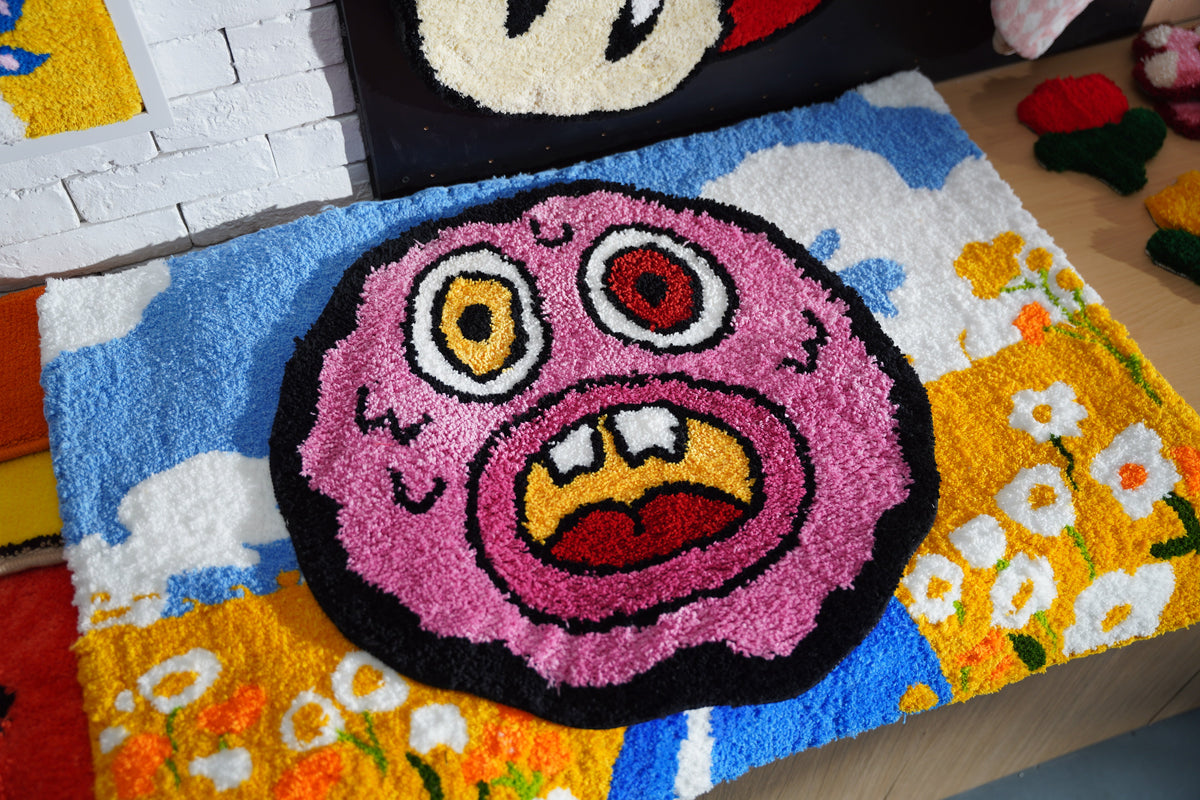
Rug tufting is a way of making a raised surface by pushing yarn through a backing cloth. The loops that emerge on the other side can stay closed or be cut open. Together they form the pile, the part of a rug you feel underfoot.
In a tufting video, the side facing the maker often shows narrow lines of stitches. Turn over a hand-tufted rug in a store and all you may see is plain fabric. Following one strand from the cone to the finished piece explains both views.
Follow one strand through the cloth
Picture a blue letter R on a cream rug. A strand of blue yarn unwinds from a cone and passes through the eye of the tufting needle. With each stroke, the needle carries yarn through the primary tufting cloth stretched across the frame. The needle draws back, a loop stays behind, and the tool moves on to the next stitch.
From the maker’s side, the blue stitches trace the curved top and diagonal leg of a backward R. Walk around the frame and the letter reads the right way. That’s why a maker tracing letters by hand starts with a mirror image. Where the stitches sit close together, the tufts hide the cloth and the rows blend into a single blue stroke.
The cloth does some of the work. Under even tension, it stays put as the needle passes between its threads. Loose cloth moves with the needle, which can leave uneven tufts. The weave grips the yarn lightly enough that the maker can still tease out a misplaced blue line and redo it before applying adhesive.
What cut pile and loop pile look like
Gently part the pile with your fingertips. In loop pile, you can follow a strand up, over a little arch, and back into the cloth. In cut pile, you’ll find individual yarn tips. A cut-pile gun snips each loop as it forms. Trimming the rug later evens out those tips.
What holds the yarn in place
The cloth’s grip gets a maker through tufting. A floor rug also has to stand up to footsteps. On a typical hand-tufted rug, the maker spreads a flexible rug adhesive across the back so it reaches the base of each tuft. As it sets, it anchors the yarn.
A second piece of fabric often covers the adhesive. That layer is the secondary backing. If you turn a finished rug over in a store, this may be the fabric you see. The primary backing is the cloth the needle passed through. It sits between the pile and that outer layer.
On the face, the maker can trim any yarn tips that stand taller than the rest. Carving does a different job. A shallow channel between the blue R and its cream background casts a fine shadow, making the letter easier to read. Our guide to rug finishing shows how gluing, backing, and trimming fit together.
What a rug label tells you
On a tag that reads hand-tufted wool, each term tells you something different. Wool names the fiber. Hand-tufted tells you a person guided the tool that made the pile. With a powered tufting gun, the motor drives the needle while the maker steers around each curve. A wool floor rug and an acrylic wall hanging can share the same construction.
A hand-knotted rug gets its pile from yarn tied around the lengthwise foundation threads. On the back of many of these rugs, you can see the design in the rows of knots. A cloth-covered underside is one clue to tufting. When the construction is hard to see, check the maker’s label.
The word tufted on its own also covers rugs made on an automated machine. For that same blue R, Craftphilia Studio mirrors the design and lays out the needle’s path. On our CF05 and CF07 machines, the tufting head follows that path and cuts each loop as it goes. When the machine finishes one color, it pauses for you to load the next. To see it at the frame, follow a first rug from design to finish.
Frequently asked questions
Is tufting the same as punch needle?
They work the same way: both push loops of yarn through cloth without knotting them. A punch needle does it by hand, one loop at a time, so it suits small pieces. Tufting uses a powered tool, which makes rug-sized pieces practical.
What’s the difference between a hand-tufted and a hand-knotted rug?
A hand-knotted rug ties every tuft onto the threads of its base, which takes a very long time and needs no glue. A hand-tufted rug pushes loops through a backing cloth, then relies on glue and a second backing to hold them. That’s why tufted rugs are faster to make and usually cost less.
Is tufting hard to learn?
The stitch itself is easy to start with. Even lines and clean finishing take practice. We broke down where the difficulty actually sits in how difficult is tufting.
What do you need to start tufting?
Primary tufting cloth, a frame, a tufting gun or machine, yarn, rug glue, backing cloth and something to trim with. Our breakdown of what it costs to start tufting puts numbers on each.
Can you tuft things other than rugs?
Yes. The same stitch makes wall hangings, coasters, and panels that get sewn into bags and cushions. Our guide to wall art, carved relief and 3D tufted objects shows how far it goes.

Share:
How to Tuft a Rug That Survives Cats and Dogs
Is Tufting Safe at Home? Managing Tools, Dust, and Glue Fumes