
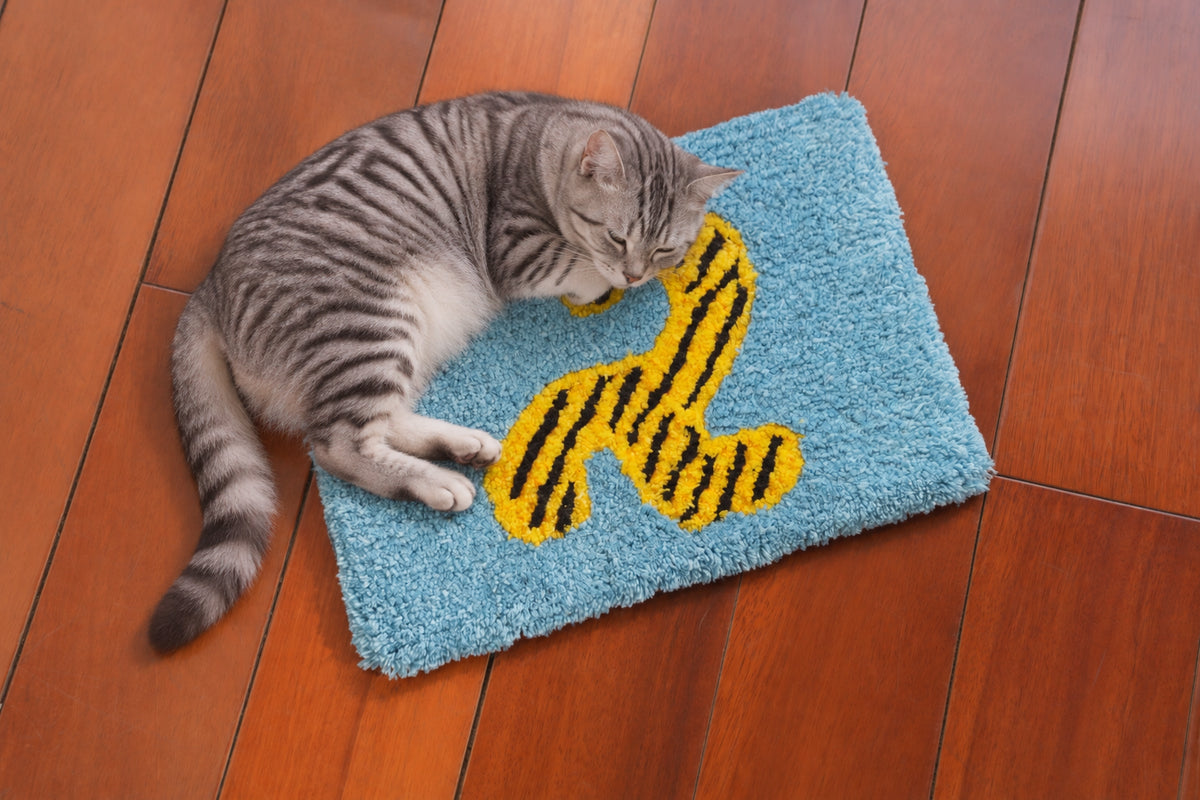
The rug you're planning is going on the floor, and the floor is the dog's territory as much as yours. Maybe the cat has already picked the spot by the window where it's going to go.
Whatever you make will be slept on, scratched, chewed at one corner and, sooner or later, cleaned up after. You don't have to give up on making it. You just have to make a few choices with the animals in mind — some before you start, and most while you finish.
Most of those choices are about construction: the kind of pile, the edges, and what's on the back. The yarn matters less than people expect.
What cats and dogs actually do to a rug
Pets damage rugs in four ways, and each one is dealt with at a different stage of making the rug.
- Claws. Cats scratch on purpose. Dogs dig, circle before lying down, and skid when they run. Anything a claw can hook is at risk.
- Teeth. Puppies chew corners. Cats go after anything that looks like string.
- Accidents. Urine, vomit, water from the bowl, muddy paws. The trouble starts when liquid soaks through to the back of the rug.
- Hair and movement. Shedding that shows on the surface, and a rug that slides out when the dog takes a corner at full speed.
With cats, most of the damage is mechanical. Dogs bring moisture as well. A house with both gets all four, so the rest of this guide takes them one at a time.
Claws: why cut pile is the rule
Read enough pet-owner advice on rugs and carpet and one rule shows up almost everywhere: no loops.
The reason is how loop pile is built. In a loop pile rug, one length of yarn runs continuously from loop to loop. A claw hooks a loop, the cat pulls back, and the yarn draws up the loops next to it. One snag becomes a run across the rug.
Cut pile doesn't work that way. Every tuft is cut at the top, so each one is a separate piece of yarn held in place by the glue at its root. A claw has nothing to hook into, and the worst it can do is catch a single tuft.
Craftphilia machines tuft cut pile only. If you also use a gun that can switch to loop pile, keep the loops for wall pieces.
Two more things help against claws:
- Shear the pile short and level. Long strands standing above the rest give claws something to grab, and they hold more hair. How short you go is up to you; what matters is an even, dense surface, and that comes from the leveling pass in rug finishing.
- Make sure the glue reaches the roots. A cut tuft stays put only if the glue got down to where it passes through the cloth. Tufts that come out under a claw usually point back to the glue step — the same cause behind most shedding problems.
No construction wins against a cat that has decided your rug is the best scratching surface in the house. Give it something better nearby. Some cats ignore vertical posts completely and want a flat scratcher on the floor — which is exactly what a rug is. Keeping claws trimmed helps too.
Teeth: leave nothing loose to pull
A loose end is an invitation. A dog that would never chew the middle of a rug will work at a frayed corner for an afternoon.
- Skip fringe and tassels. On a floor with pets, they look like a toy.
- Carry the glue past the edge of the design. The outer rows are where chewing starts, and they need to be locked down as firmly as the middle.
- Fold the hem all the way under and glue it flat, so there's no raw edge of cloth for teeth to start on. If your dog goes for corners, bind the edge with twill tape as well. The finishing steps, including the hem, are in our guide to rug finishing.
- Clean up after shearing. Trimming leaves clippings on the rug and the floor, and usually a few long tails the trimmer missed. Snip the tails flush and vacuum the rug and the room before the animals get near it. Put yarn cones and scraps away while you work, too.
Swallowed yarn is a real emergency, especially for cats. The backward-facing barbs on a cat's tongue make it hard to spit string back out. A long strand that reaches the intestine can make the gut bunch up around it, and that usually means surgery. If you ever see yarn hanging from a pet's mouth or from the other end, don't pull it. Call your vet.
Accidents: the back of the rug is where it fails
The weak point of a tufted rug is its back. The glue layer holds every tuft in place, and the backing sits on top of it. When urine soaks through to that layer, it's very hard to get out, and the smell stays with it. That's the main reason pet owners get told to avoid tufted rugs altogether.
When you make the rug yourself, the back is in your hands.
- Cover the whole back evenly. Work the glue down into the roots instead of spreading it across the top, and leave no thin patches.
- Let it cure fully before the rug comes off the frame. Dry to the touch doesn't mean cured. A rug cut off early sheds later, and in a pet home the edges go first.
- Start from a cloth made for tufting. Burlap is a poor base for any rug and a worse one for a rug that will see accidents, because jute soaks up liquid. Our comparison of tufting cloth, monk's cloth and burlap explains why it fails even before it gets wet.
- Keep plant fibers off the back as well. Jute backing has the same problem as burlap: it holds liquid, and smell goes with it. A polyester backing like Craftphilia Backing Cloth avoids it.
The yarn makes a difference here, though less than the back does. Craftphilia yarn comes in acrylic and milk cotton:
- Acrylic is easy to spot clean, takes in little liquid, and holds its color through repeated cleaning. If accidents are likely, it's the simpler choice.
- Milk cotton is soft underfoot, but cotton soaks up liquid readily — better suited to wall pieces, or to rugs in rooms where accidents are unlikely.
- Wool, if you source it elsewhere, springs back well, and its natural lanolin helps spills bead up at first. But it takes in more liquid than acrylic once a spill sits, and that's where smells come from.
Our guide to how yarn material changes the way a rug lives goes further into the differences.
Whether a finished rug can go in a washing machine depends on the yarn and the backing. For most pet rugs, plan on spot cleaning. That's one reason to keep pet rugs small where you can: a rug you can pick up and carry outside is easier to deal with, and easier to make again. A feeding mat fits comfortably inside the CF05's 19.7 × 19.7 inch (50 × 50 cm) tufting area.
When an accident happens:
- Blot, don't rub. Rubbing pushes liquid deeper toward the back.
- Use an enzyme cleaner for urine. It breaks down what causes the smell instead of covering it.
- Never use a steam cleaner on urine. The heat sets both the stain and the smell.
If a pet keeps going on the rug — especially one that's house-trained — mention it to your vet. It can be a sign of illness, not just bad manners.
Hair and zoomies: color, pattern and grip
Hair is the one problem you can design around before the first stitch.
Pick colors close to your pet's coat. A pale rug under a black dog shows every hair, and so does a dark rug under a white cat. Mid-tones are the most forgiving.
Use pattern. A busy design with several colors breaks up shed hair, so it shows less between vacuums. A large flat area in one color shows everything. If the rug is a portrait of the pet itself, our guide to making custom pet portrait rugs covers the design side, including the photos that work best.
Make sure it stays put. A rug that slides under a running dog is a hazard for the dog and for anyone walking past. On a hard floor, finish the rug with a non-slip backing such as Craftphilia Backing Cloth, or put a rug pad underneath. With a large dog, do both.
A rug built for the household it's going into
Put together, a rug that lives with pets comes down to cut pile sheared short and level, glue worked to the very edge and left to cure, a back that doesn't soak up liquid, and nothing loose anywhere for a claw or a tooth to start on.
If this will be your first piece on the machine, our walkthrough of your first rug on an automated tufting machine takes it from design to finish.
Frequently asked questions
Will my cat scratch a tufted rug?
Some cats will. A cut pile rug gives claws far less to catch on than a loop pile one, so occasional scratching usually doesn't do much. A cat that scratches the same spot every day needs a better option nearby — often a flat scratcher rather than a vertical post.
What yarn is best for a rug in a home with pets?
Acrylic. It takes in less liquid and is easier to keep clean, which matters most with dogs and accidents. Milk cotton is softer but absorbs spills; wool recovers well from being pressed down but holds onto liquid once a spill sits. If you're unsure, acrylic is the safer choice.
Can I put a tufted rug in the washing machine?
It depends on the yarn and the backing. For most rugs, spot cleaning is the safer routine. Keeping pet rugs small makes them easier to clean either way.
Is rug glue safe around pets?
Keep pets out of the room while you glue and while the rug cures, and keep the room ventilated. Don't put the rug down until the glue has fully cured.

Share:
Your First Rug on an Automated Tufting Machine: From Design to Finish
How Tufting Turns Yarn Into a Rug