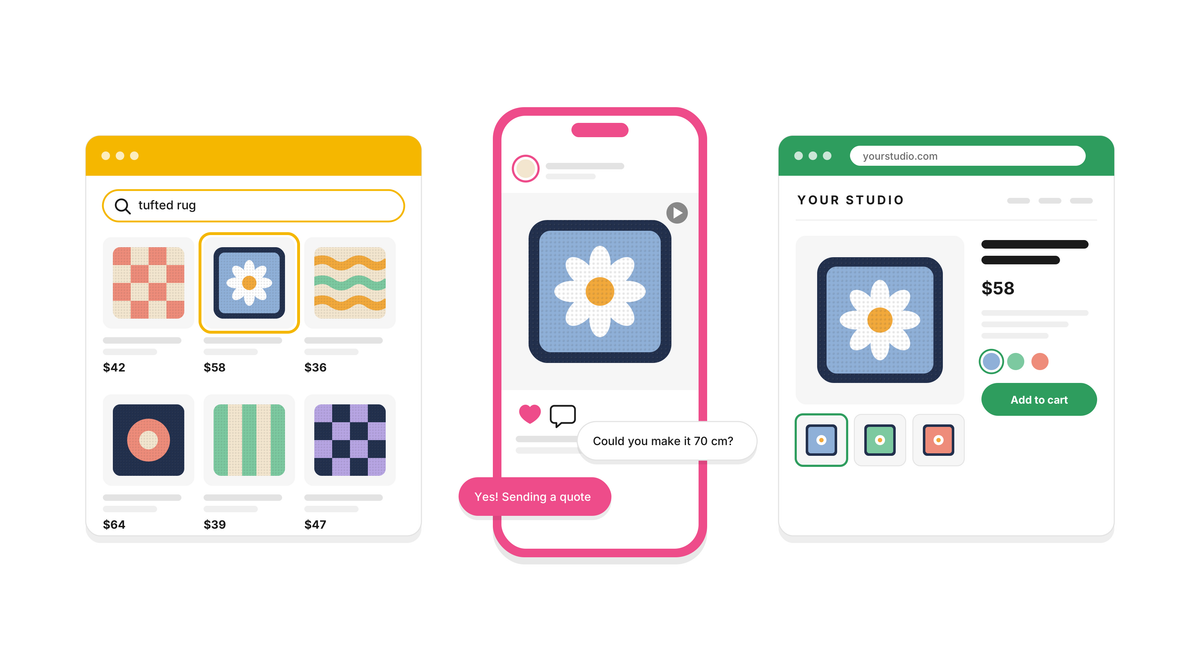
Etsy, Instagram and your own website can all sell a tufted rug. Where they differ is who finds you, who takes the payment, and how much of each sale is your own work.
Etsy brings buyers who are already searching. Your own site keeps the customer. Instagram shows a rug better than either, but every sale there runs through your messages. Most makers end up using two of the three — which two, and in what order, depends on where you are now.
| Etsy | Your own site | ||
|---|---|---|---|
| Who finds you | Strangers searching for what you make | People the feed shows your work to | People you send there, then people who search your name |
| Who takes payment | Etsy | You, by invoice — or your site | Your site |
| What it costs | A share of every order | Your time in messages | A monthly plan, and finding your own visitors |
| Best for | Starting from zero followers | Showing the work and the making | Repeat customers and custom work on your terms |
Selling on Etsy
Etsy earns its fees when buyers already know what to type.
It's a marketplace: Etsy runs the search, the checkout and the rules, and takes a share of each order in return. "Dog portrait rug", "nursery name rug", "custom logo mat" — these are searches with a buyer behind them, and on Etsy those buyers find you before they've ever heard of you. For a maker with no following yet, nothing else on this list can do that.
It suits:
- Work that fits a search phrase. Personalised pieces, set sizes, clear subjects.
- Finding out what sells. A listing costs $0.20, and your shop stats show which designs people actually click.
- Makers starting from zero followers. Search doesn't care how many people know your name.
It's a weaker fit for work that only makes sense once you know the maker: a distinctive style, one-off art pieces, large rugs at a serious price. In search results these sit in a grid beside cheaper thumbnails — printed rugs included — and that grid rewards price. (What actually sells looks at why.)
For opening the shop, Etsy SEO and the 2026 fees line by line, see how to start an Etsy tufting shop.
Selling on your own site
A website starts paying for itself the day people search for your name instead of for "tufted rug".
It's a shop with your name over the door. Nobody walks past it by accident: until your name is known, almost every visitor is someone you sent — from Instagram, a market stall, or a card in someone's hand. That's enough for commissions. It isn't enough to be found.
What it gives a rug maker in return:
- Custom work on your terms. A brief form that asks for size, colours and a reference image up front, a deposit taken before you start, and your revision limit written into the order.
- The customer, not just the sale. Every order comes with an email address, so the next rug — a matching one, a gift, a second room — is a message away.
- Your work shown together. Colourways, sizes and series on one page, with no row of competitors underneath.
- No marketplace cut. Payment processing still applies, but nobody takes a percentage of a large rug and its shipping on top.
What it costs: a monthly plan, a domain, and the job of bringing in visitors yourself. For most makers, a site is the second step, not the first — unless Instagram already brings you more enquiries than you can answer in messages.
Selling on Instagram
On Instagram, a sale starts in your messages and ends with an invoice you send yourself.
Instagram's own shop checkout ended in September 2025. Tapping a tagged product now sends the buyer to a website to pay. Without a website, selling here means agreeing the piece in messages, sending an invoice, and taking payment through it.
Rugs suit Instagram better than most crafts, because the things a still photo struggles with are easy to show in fifteen seconds of video: a hand running across the pile, an edge being carved, the finished piece on a real floor at real size. The making holds attention too, from the first rows going into the cloth to the finished piece coming off the frame.
A few things make it work:
- Send the bio link to one place. Your Etsy shop, your site, or a page of what's available now — not a menu of five.
- Expect commissions to start in messages. Someone who wants a rug made wants to talk to the person making it.
- Put it in writing before you start. When a commission is agreed in messages, send a proper invoice and take the deposit through it. A chat thread is not an order.
The limits show up as orders grow. Every sale is a conversation, which is fine at a few a month and a second job at a few a week. Nobody arrives on Instagram already searching for a rug the way they do on Etsy, and who sees your posts depends on what the feed decides to show that week.
That's why, for most rug makers, Instagram works better as the way in than as the shop itself. It's where people decide your work is worth the price. The sale goes more smoothly somewhere built to take payment.
Running more than one channel
Most makers end up running two of these at once, and the one rule to know is Etsy's.
Etsy's Off-Platform Transactions policy doesn't allow a transaction that starts on Etsy to finish anywhere else. Its own examples include making offers to buy or sell outside Etsy, encouraging buyers to purchase an item from your Etsy shop through another venue, and using a QR code to send people off Etsy. In practice:
- No discount cards for your website in Etsy parcels — and no QR codes in them that lead off Etsy.
- No moving a buyer from Etsy messages to Instagram to agree a commission there.
- No extra charges after checkout. Shipping, duties and any other fees have to be in the original order — worth getting right for large rugs, where shipping is a big part of the price.
What the rule doesn't touch is everything outside Etsy: your Instagram and your site can point wherever you like, including to your Etsy shop.
How that plays out depends on the pair:
- Etsy and Instagram is the usual start. Instagram shows the work and the bio link goes to your Etsy shop, where every sale and review lifts your listings in front of strangers you can't reach yet. A commission that begins in your Instagram messages never touched Etsy, so it can stay there and be invoiced as usual.
- Instagram and your own site don't conflict at all. The bio link and product tags send people to your site, and the site takes over the checkout your messages were doing.
- All three comes once your name brings in enough traffic on its own. Move the bio link from Etsy to your site, and split the two shops by who's buying: Etsy for strangers who found you through search; your site for people who already know you — followers, repeat customers, businesses ordering logo pieces.
Whatever the mix, a one-of-a-kind piece offered in two places can sell twice. List finished single pieces in one place only, and keep made-to-order designs — the ones you can make again — in all of them.
Match the channel to what you can make
Every channel here asks for the same thing in a different form: a steady supply of finished work.
Etsy rewards shops that keep listings fresh and ship on the date they promised. Instagram rewards new work, often. A site needs a range worth browsing. A maker who finishes one rug a week can keep one of those fed, not three.
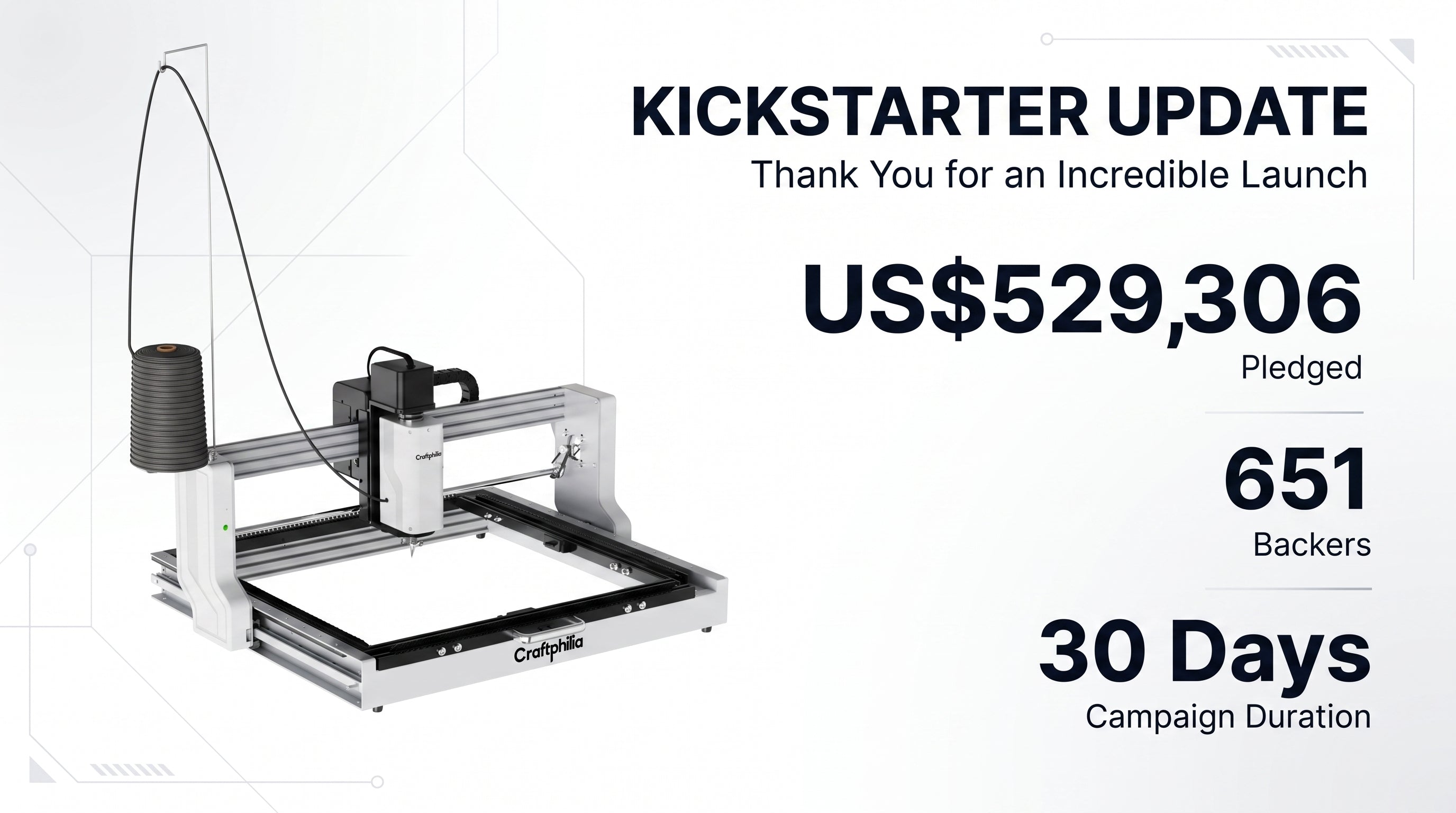
This is where a Craftphilia machine changes the arithmetic. Once a design is set up in Craftphilia Studio, the machine tufts it in one to five hours. It pauses at each colour change for you to swap yarn and runs on its own in between. Every piece of a design comes from the same file, so one design can sit on Etsy in three colourways and come back months later as a reorder from your site (making multiples).
The hours you get back go to the parts every channel actually runs on: finishing (what rug finishing involves), photos and video, and answering the people who write to you. For how the machines work, see our complete guide to automated tufting machines.
Where to start
Start where your buyers already look. For most new makers that's Etsy, with Instagram showing the work. If Instagram already brings you more enquiries than your messages can handle, start with a site instead.
Add a site of your own when people start asking for you by name. That's the point where it stops being a cost and becomes the place your best customers buy.
Frequently asked questions
Can I sell tufted rugs on Instagram without a website?
Yes, through messages: agree the piece, send an invoice, take a deposit. What you can't use without a website is product tags, since they now send buyers to a website to pay.
Is Etsy still worth it in 2026?
For a maker without an audience, yes. Etsy ended 2025 with 86.5 million active buyers, down 3.4% on the year, according to its annual results. Fewer buyers means more competition in search, but it's still a crowd that arrives looking to buy — which neither Instagram nor a new site can give you.
Can I put a link to my website in my Etsy orders?
Better not. Etsy doesn't allow encouraging Etsy buyers to purchase elsewhere, and it specifically names QR codes that send people off Etsy. Keep Etsy orders on Etsy, and let your Instagram and your site do the pointing.
Which channel is best for custom rugs?
Open-ended commissions — the customer's own design, an unusual size, several rounds of mockups — sit best in messages and on your own site, where you set the deposit and the revision limit. Personalisation within fixed options (set sizes, a set style, the buyer's name or pet) works well on Etsy, because buyers search for exactly that (how pet portrait rugs are made and priced).
Do I need to be on all three?
No. Most makers start with one channel that sells and one that shows the work, and Instagram can be either. Add the next one when the first two can't keep up with the people asking.
Share:
How to Start an Etsy Tufting Shop (and Keep the Orders Coming) in 2026