
Most advice on selling tufted rugs is about which website to list them on — we've covered that in Etsy, Instagram or your own site. This piece is about the three places a rug is sold person to person: a market stall, a custom order, and an interior designer's project.
They tend to come in that order. People first meet your work at a market. Some of them come back with something they want made. And a few of the people who order — or who see what you made for someone else — furnish rooms for a living, and come back with the next project.
Each of the three asks something different of you.
Three buyers, three different purchases
The person at your stall is buying something they can touch and carry home today. A custom buyer is paying for a rug that doesn't exist yet, so what they're really buying is your ability to make what they described. A designer is buying for someone else's room, and what they pay for is predictability: the piece that arrives has to match what they showed their client.
| Market | Custom order | Interior designer | |
|---|---|---|---|
| What they're buying | A finished piece they can touch | A rug made to their brief | A piece for a client's room, made to spec |
| What you need ready | Stock at several price points | A clear process: brief, design, deposit | Samples, specs and a lead time you keep |
| When you're paid | On the spot | Deposit first, balance at the end | Per order, at a trade price |
| What it leads to | Commissions | Referrals and repeat orders | Repeat projects |
Selling at markets and fairs
A tufted rug is a considered purchase, and most market shoppers are browsing on impulse. That mismatch decides how a stall should work.
Rugs stop people. They're colorful, they're tactile, and plenty of people walking past have never seen tufting before. Few of them will decide on a 60 cm piece in the minute they spend at your table, though. On the day, it's the small pieces that sell — coasters, mug rugs, mini rugs and mirror surrounds. The larger pieces do a different job.
Build a price ladder. Have small pieces for an easy yes, mid-size pieces people will think about, and one or two statement pieces at the top. At the stalls we've looked at, prices run from about $15 for the smallest pieces to several hundred dollars for the largest. The statement piece rarely sells that day, but it makes the mid-size prices look reasonable and starts conversations.
Choose markets where people come to buy for their homes. Art and design markets, makers' fairs and holiday gift markets all suit tufted work. At a bargain swap meet, expect someone to laugh at a $200 rug. That can still be worth doing if the small pieces sell — but it's a small-piece day.
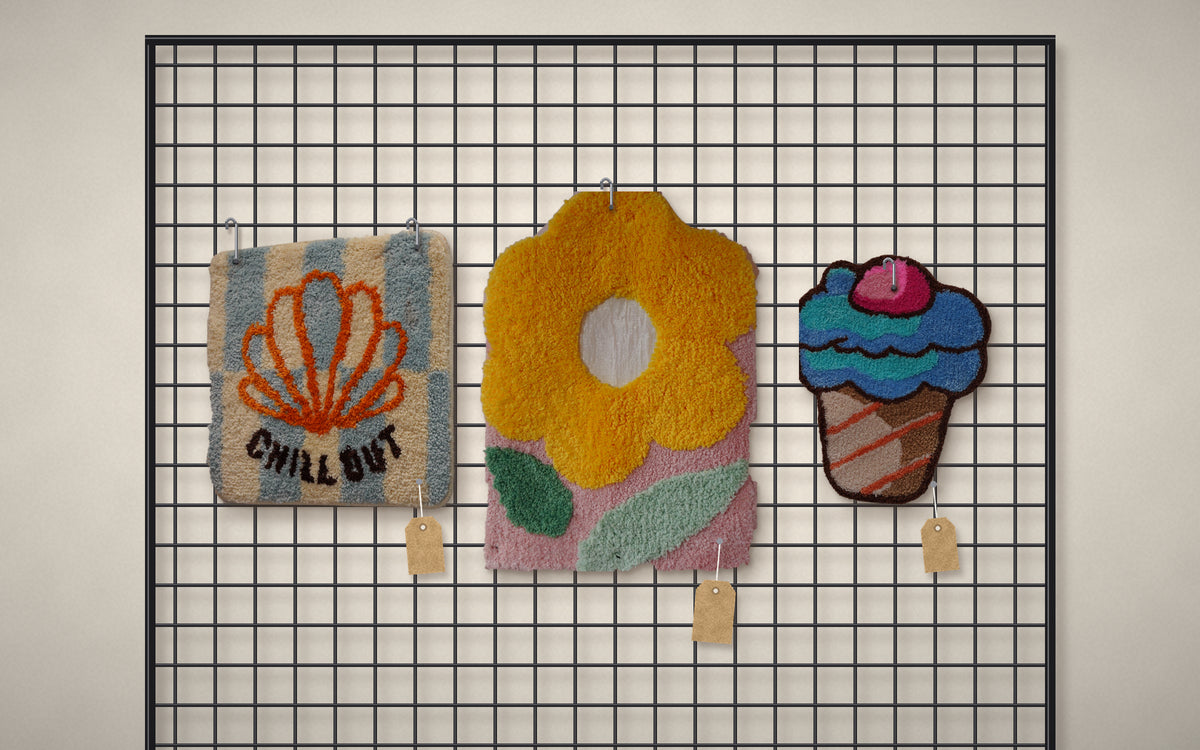
Hang the work. Rugs laid flat on a table look like a pile of fabric; on grid panels at eye level, they look like finished pieces. Keep one piece low enough that people are invited to touch it, and put a basket of small pieces at the front. A short sign explaining how a piece is made does more than you'd expect, because the carving and finishing are invisible unless someone points them out.
Roll the rugs, never fold them. A fold can crack the glue layer and leave a crease that won't come out. Roll them with the pile facing out, so the glued backing sits on the inside of the curve instead of being stretched. Give every buyer a care card: spot clean only, no washing machine.
The real return from a stall is the commissions that come afterward. Every market brings people who liked a piece but wanted it bigger, in their own colors, or with their dog on it. Make that easy for them:
- a card with your link;
- a few set sizes with a starting price beside each;
- a way to take a deposit on the spot.
Between markets, the question is whether you can restock what sold. On a Craftphilia machine, a design that sold out tufts again from the same file, with the same outlines and color blocks as the first. Your hours go into finishing — the part people at the stall were running their hands over. For restocking several pieces at once, see making multiples.
Running commissions without the guesswork
A custom order is sold before it's made, so most of the job is managing what the buyer expects. The making is the predictable part.
Commissions come from conversations: a stall, a message, a friend of someone who bought from you. Large pieces in particular sell this way. A big rug sitting in stock at a four-figure price tends to stay there, while the same size in the buyer's own colors sells — because they decided they wanted it before you made it.
The process that holds up has five steps:
- Take a written brief. Ask for the size; where it will go (floor or wall, and which room); the colors; a reference image; a budget; and the date they need it. A form on your site or a checklist you send in messages both work. A chat thread on its own isn't a brief.
- Give a starting price before you design anything. Enquiries tend to fall apart when the price arrives after the design work (custom versus ready-made). A price range by size, given early, sorts the serious buyers from the curious ones.
- Send the design, and say how many revisions are included. The customer is approving a flat image of color blocks, not a photo of a finished rug. For a floor rug, drop the design into a photo of their room so the size reads correctly. Custom pet portraits walks through this step in detail.
- Take the deposit, then tuft. Around half up front is common on larger pieces. It covers your materials and stops you tufting for someone who has changed their mind (how to price your handmade rugs).
- Photograph the finished piece before it ships. Send a photo of the rug laid flat or hung, and take the balance once they approve it. If the buyer later says it isn't what they expected, that photo is what you point to.
In Craftphilia Studio, the design the customer approves is the same file the machine tufts from, at the same size. How many yarn colors that design keeps is covered in color tolerance; matching each one to a yarn you can actually buy is what our numbered color system is for. The time you save at the frame goes to the two parts of a commission that actually take time: talking with the customer, and finishing the rug.
Commissions are also where requested sizes get big. A CF07 with its Expansion Kit tufts up to 70 × 140 cm in one piece. Larger rugs are tufted in sections and joined after finishing — which is how oversized pieces have always been made, whatever the tool (choosing a machine size).
Working with interior designers
A designer is buying for someone else's room, and what they're paying for is that nothing goes wrong.
Interior designers furnish homes, and some also do hotels, restaurants and offices. A rug is one line in a scheme they've already shown their client: the colors, the size, often a sketch of where it sits. So they come to a maker in one of two ways. Sometimes they find a finished piece that already fits the scheme. More often they bring a brief and ask you to make it. Occasionally that brief includes their own design; usually it's a palette, a size and a mood, and you design within those limits.
They usually buy at a trade price, then either sell the rug on to their client or bill it as part of the project. That margin is part of how they're paid for sourcing, which is why a designer will ask for a trade discount. From what we've seen, 10–20% off retail is a normal starting point. Set your retail price so it can absorb that discount, instead of discounting below what the rug costs you.
Where tufted work fits
Designers turn to tufting when they need something they can't buy off the shelf: an awkward size, a shaped outline, or a color matched to a fabric. Tufted rugs suit bedrooms and quieter rooms better than a busy hallway.
Tufting is at its strongest on the wall. Tufted pieces soften sound, which is why you'll find them in hotel rooms and offices as well as homes (tufted wall art).
What a designer asks for before ordering
- A sample they can hold. A small swatch in the actual yarns, to put against the fabric and paint. A photo won't do, because screens shift color.
- Specs. The fiber, the pile height, the backing, the finished size, how to clean it, and where it shouldn't go. Designers pass this on to their clients, and they're the ones blamed if it's wrong.
- A lead time you keep. Their project has an installation date, with other trades booked around it. Quote from your real queue, and include gluing, drying and finishing — not just the tufting.
- A finished piece that matches the sample. The rug that arrives has to look like the swatch they approved, and a second piece ordered six months later has to sit beside the first without looking like a different batch. In practice, that means recording the yarns for every design and buying from one dye lot.
That last point is usually where a designer decides whether to come back. It doesn't mean every piece has to be identical — a set of wall pieces for a hotel can be different designs. It means every piece in the set is finished to the same standard, and each one matches what was approved.
This is where a machine pays off in trade work. A CF05 or CF07 tufts the swatch and the full-size piece from the same file, along the same paths, and a reorder months later uses that file again. The hours you get back go into finishing every piece in a set to the same standard.
Finding designers
- Start with the ones you've already met. Designers shop at markets and follow makers online, and some of your custom buyers will turn out to be designers. Ask them.
- Go where designers meet. Local design associations, design weeks and showroom events.
- Look at their work before you write. Search Instagram and LinkedIn for designers near you, and contact the ones whose rooms suit what you make.
- Make your terms easy to find. Put them on one page of your site: the trade discount, what a sample costs, your lead times and how to order. A designer who finds you can then check everything without writing to you first.
When you get in touch, send a short lookbook with sizes and a price range, and ask whether they have a project coming up.
Building up to trade work
Start with markets and custom orders, and let designers come later. A designer will want to see finished commissions, a sample process and lead times you've actually kept — and you build all of those by doing the first two for a while.
Each step needs more finished pieces you can make again. A market needs stock. Custom orders need space in your week. Designers need every piece in a set to come out the same. How much of each you can take on depends on how many pieces leave your studio each week (the complete guide to automated tufting machines).
Frequently asked questions
Do tufted rugs sell at craft fairs?
They do, but on the day it's mostly the small pieces. Larger rugs sell less often at the stall; more often they sell afterward, as commissions from people who met you there.
What discount do interior designers expect?
Around 10–20% off retail is a common starting point. Build that into your retail price instead of discounting below what the rug costs you to make.
Do interior designers buy handmade tufted rugs?
Yes, when a project needs something they can't buy ready-made: a specific size, a shaped piece, a color matched to the scheme, or a wall piece. Expect them to ask for a sample and specs first.
How long should a custom tufted rug take?
Work it out from your queue, not from the tufting time. Add up the orders ahead of it, then the tufting, a day for the glue to set, and the finishing. On a Craftphilia machine the tufting itself takes one to five hours; the queue and the finishing decide the rest.
Can I make a rug bigger than my machine?
Yes. Tuft it in sections and join them after finishing. On a CF07 with its Expansion Kit, each section can be up to 70 × 140 cm.
Should designers pay for samples?
Many makers charge for samples, then credit the cost against the order. A designer who goes ahead pays nothing extra, and you aren't tufting free swatches for every enquiry.

Share:
Should You Sell on Etsy, Instagram, or Your Own Site?(2026)
How to Set Up a Home Tufting Studio